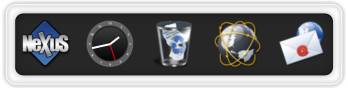
Launch, organize, monitor, and manage your Windows workspace with the free Nexus Dock.
1. Introduction
This guide explains the free version of Nexus. It covers the Nexus Preferences dialog, the Dock, Dock items, modules, internal commands, themes, task management, and practical day-to-day workflows.
1.1 What is Nexus?
Nexus is a high-performance Dock for Windows. It gives you a fast, skinnable place to launch applications, manage running tasks, access folders and system locations, host supported modules, and run built-in Winstep commands.
1.2 The Winstep product family
Nexus is the free version of the Winstep Dock. It provides a single Dock for launching applications, managing running tasks, using modules, and customizing the desktop with themes, icons, and effects.
Winstep also offers commercial products for users who want to build larger workspaces. Nexus Ultimate adds multiple Docks, Sub-Docks, Shelves, Drawers, Grid Stacks, Launch Pads, and additional modules. Winstep Xtreme is the full suite and adds WorkShelf, NextSTART, desktop modules, skinnable menus, hotspots, and a skinnable taskbar replacement.
This guide documents the free version of Nexus. Features that belong only to Nexus Ultimate or Winstep Xtreme are not described here unless they are mentioned briefly for comparison.
2. Core Nexus concepts
2.1 The Dock
The Dock is the central Nexus object: a launcher, task manager, and desktop organizer that can sit on any screen edge, float on the desktop, auto-hide, dodge windows, show running applications, host supported modules, and provide fast access to files, folders, applications, and internal commands.
The Dock is usually the fastest way to reach daily applications and frequently used folders. It can also replace or supplement parts of the Windows taskbar, depending on how you configure task and tray options.
2.2 Modules
Modules provide live information and controls in compact iconic form on the Dock. The free version of Nexus includes the supported iconic modules documented in this guide, such as Clock, Recycler, CPU Meter, RAM Meter, Net Meter, Email Checker, Weather, and Wanda.
2.3 Internal Commands
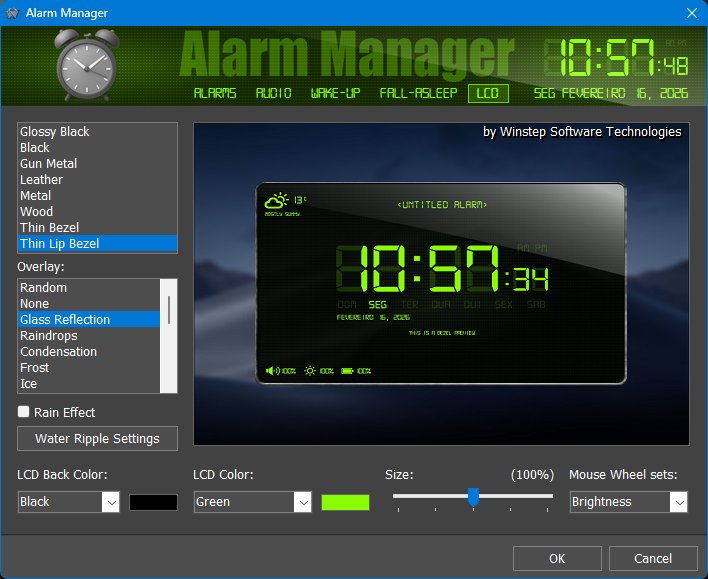
Internal Commands are built-in actions that can be added to the Dock like normal items. They can show the Start Menu, empty the Recycler, open the Alarm Manager, capture a screenshot of the desktop, control media playback, toggle Power Saving Mode, and perform many other system or Nexus actions.
Right-click first. Nexus makes extensive use of right-click context menus. The Dock, Dock items, modules, running tasks, tray items, folder menus, and many controls have their own context menus. When you want to change or act on something specific, right-clicking it is often the fastest way to find the relevant options.About features not included in free Nexus. This guide documents only the free Nexus feature set. Commercial Winstep products add larger workspace containers and extra modules, but those objects are not documented as Nexus features here.
3. Nexus Behavior and Windows Integration
Nexus is not just a static row of shortcuts. The Dock works together with Windows to launch applications, show running tasks, handle modern app shortcuts, respond to monitor changes, avoid full-screen applications, and provide access to useful system features.
This chapter explains behavior that affects several parts of Nexus at once. These features are described here before the detailed Preferences sections so the rest of the guide can refer back to them without repeating the same explanations.
3.1 Modern Windows integration
Nexus integrates with Windows shell features, application shortcuts, running tasks, folders, document types, monitors, DPI scaling, and full-screen detection. Some of this integration is visible directly on the Dock, while other parts affect how items are launched, displayed, grouped, or managed.
3.2 Modern applications, UWP apps, and PWAs
Nexus can work with traditional desktop applications, UWP apps, and supported browser-installed Progressive Web Apps. Current PWA support lets Chrome, Brave, Microsoft Edge, and Vivaldi PWAs behave as separate app-like items instead of being grouped only as ordinary browser windows. When a PWA does not provide a usable application icon, Nexus displays a default PWA icon instead.
This applies to the Dock and task management features in Nexus, including pinning, launching, running indicators, task grouping, recent files, and icon handling where supported.
3.3 Multi-monitor profiles and high-DPI support
Multi-monitor profiles are intentionally user-transparent. In normal use there is no profile editor to manage: Nexus detects the active monitor configuration, saves the Dock layout for that configuration, and restores it when the same configuration appears again.
This helps prevent the Dock from being stranded on missing monitors, squeezed onto the wrong display, or constantly rearranged when switching between laptop-only, office-dock, external-monitor, and presentation setups.
The feature also works together with per-monitor high-DPI support so the Dock can be restored to the correct monitor and rendered at the correct scale for that monitor.
Automatic monitor profiles can be disabled in the General tab of Preferences.
3.4 Full-screen applications and games
When a full-screen application such as a game is running, Dock activation methods are disabled and active modules on that monitor reduce or stop updating to save CPU cycles. This prevents an accidental screen-edge bump from disrupting a game or other full-screen application.
Applications that should not trigger this behavior can be added to the Full-Screen Exclusion List. This is useful for applications that use borderless full-screen windows, unusual display modes, or custom rendering surfaces but should still allow normal activation behavior.
The Full-Screen Exclusion List is a global setting and can be accessed from the More Options dialog in the General tab of Preferences. It is also available from the Activation Settings panel in Preferences.
4. Working with Dock Items
Why this chapter exists. Nexus is built around Dock items, not just ordinary shortcut icons. Applications, folders, documents, URLs, modules, internal commands, running tasks, and tray items can be combined, customized, filtered, dragged, dropped, and used together. This chapter collects everyday techniques that apply to Dock items and related menus.
4.1 Context menus as a command surface
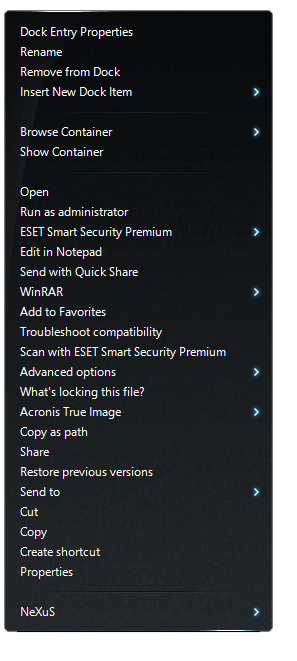
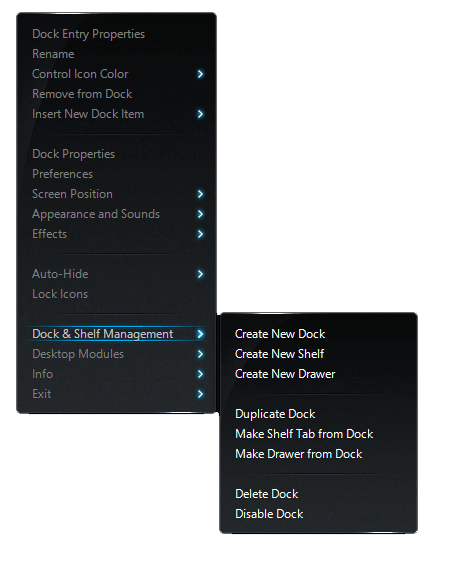
Right-click context menus are one of the main ways to work with Nexus objects. They are not limited to simple commands: they can expose item properties, insertion commands, shell commands for the underlying file, theme and style controls, Dock commands, module-specific settings and parent-object menus. When you are looking for a command related to a Dock item, folder menu, workflow shortcut, module, running task or tray item, right-click it first.
4.2 Dock item types at a glance
Item type
Main purpose
Best used for
Application shortcuts
Launch applications and represent running tasks.
Daily programs, pinned apps, and task management.
Folders and documents
Open or browse local content.
Project folders, frequently used files, and quick folder menus.
Modules
Show live information in compact iconic form.
Clock, weather, system meters, email status, Recycler, and Wanda.
Internal Commands
Run built-in Nexus and system actions.
Start Menu, media controls, screenshots, power actions, updates, alarms, and similar commands.
Separators and visual items
Organize the Dock visually.
Grouping related items and improving readability.
Nexus is easier to understand if you think of the Dock as a flexible row of item types rather than as a simple shortcut bar.
4.3 Item Properties
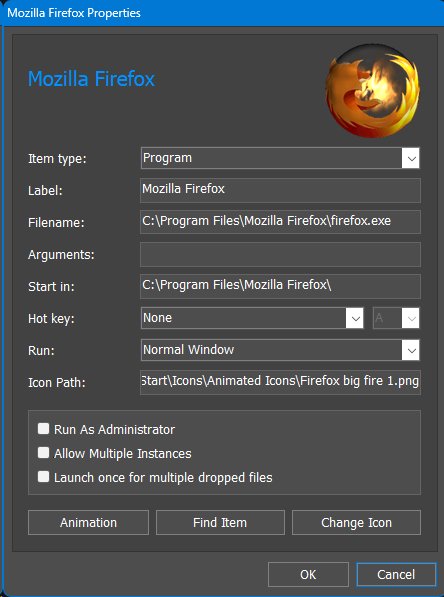
The Item Properties dialog configures an individual item on the Nexus Dock. It is where you change what an item launches, its label and icon, command-line parameters, working folder, hot key, launch behavior, and other settings specific to that item.
Open it by right-clicking a Dock item and selecting Item Properties. The controls shown in the dialog change according to the selected Item type. For example, a Program item uses fields such as Filename, Arguments, and Start in, while selecting Module changes the Filename field into a Module selector from which one of the available Nexus modules can be chosen. Some modules and Internal Commands also reuse other fields for settings that are specific to that item.
Item Properties dialog item-properties.jpg
Item type. Selects what kind of Dock item is being configured. Nexus supports item types such as Folder, Program, Internal Command, Module, Item Separator, and URL. The function of some fields below changes with the selected type. For example, selecting Module changes the Filename field into a Module selector. For some module configurations the Arguments field is also repurposed; a clock item that supports a selectable time zone, for example, can use that field as a Time Zone selector instead of as normal command-line arguments.
Label. Sets the name displayed for the item in labels, tooltips, menus, and other places where Nexus identifies that Dock item. The label does not have to match the filename or application name, so it can be made shorter or more descriptive.
Filename / target field. For a Program item this specifies the executable, document, script, or shortcut to launch. For a Folder item it specifies the folder. For a URL item it contains the web address. For a Module item the field becomes the Module selector, and for an Internal Command it becomes the command selector.
Arguments. Specifies optional command-line arguments passed to a program, script, or batch file. This can be used for switches, document paths, or any other parameters accepted by the target. For item types that need a different kind of parameter, Nexus can change the purpose of this field accordingly.
Start in. Sets the working folder used when launching a program, script, or batch file. This is particularly important for programs that use relative paths or expect supporting files to be found in a particular folder.
Hot key. Assigns a global keyboard shortcut to the item. Once assigned, the item can be launched with that hot key even while you are working in another application, provided the Nexus Dock hosting the item is enabled. This makes hot keys useful for tools, folders, documents, scripts, and Internal Commands that you want to reach immediately without first bringing the Dock to the foreground.
Hotkey Manager. The Hotkey Manager in the Troubleshooting Options dialog provides a central list of assigned hot keys. This is especially useful for item hot keys because otherwise finding which Dock item owns a particular key combination could require opening Item Properties for items one at a time. From the Hotkey Manager you can review, change, or remove assigned hot keys in one place.
Run. Selects the initial window state requested when launching a normal desktop application, such as Normal Window, Minimized, or Maximized.
Icon Path. Shows the image or icon source currently assigned to the item. Nexus can use ordinary icon resources as well as supported image files such as PNG, ICO, TIF, and WebP. A specially formatted PNG strip can also be used as an animated icon.
Run As Administrator. Launches the selected item elevated. Windows may display a UAC prompt when the item is launched. This should normally be enabled only for utilities or commands that actually require administrator privileges.
Allow Multiple Instances. By default Nexus can be configured, like the Windows taskbar, not to launch a second copy of an application when an instance is already running. Enabling this option overrides that behavior for this particular item and allows a normal left-click to launch another instance. Even when this option is not enabled, a second instance can still be requested explicitly by launching the shortcut with the middle mouse button instead of the left button, as with the Windows taskbar.
Launch once for multiple dropped files. Controls what happens when several files are dropped onto the same application, script, or batch-file item at the same time. When enabled, Nexus launches the target once and passes all of the dropped files to that single launch. This is necessary for tools that must receive several files together - for example, a CMD batch file designed to merge two PDF files into one. When the option is disabled, Nexus launches the target separately for each dropped file. That can also be useful: dropping several text documents onto a Notepad item, for example, can open a separate Notepad instance for each document even when the application itself would not normally do that from one multi-file launch.
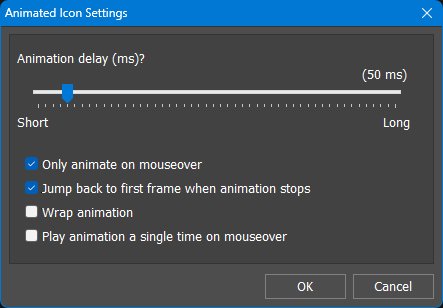
Animation. Opens the Animated Icon Settings dialog when the selected icon is an animated PNG strip. The dialog controls the frame delay and how the animation starts, stops, and repeats.
Find Item. Provides a convenient way to locate/select the target used by the current item when you need to change what the shortcut points to.
Change Icon. Opens the icon browser so a different icon or image can be assigned to the item. Module items use a specialized version of this dialog because iconic modules draw live information over module-specific backgrounds rather than behaving as ordinary static icons.
Animated icons
Nexus supports animated icons stored as a single horizontal PNG image strip. The PNG contains a sequence of square animation frames placed side by side. Nexus automatically recognizes such an image as an animated icon when it contains at least three frames and dividing the total image width by the image height produces an integer. That integer is used as the number of frames.
For example, a PNG that is 256 pixels wide and 64 pixels high is interpreted as four 64 x 64 frames. A 640 x 64 strip would contain ten frames. This lets an animated icon remain a single portable PNG file while still providing all of the frames required for the animation.
Animation delay (ms). Sets the delay between frames. A lower value produces a faster animation; a higher value makes it slower.
Only animate on mouseover. Keeps the icon static until the pointer moves over it. This is useful when the animation is intended as interactive feedback rather than something that should run continuously.
Jump back to first frame when animation stops. Restores the first frame when the animation ends. This is useful when the first frame represents the normal resting appearance of the icon.
Wrap animation. Loops from the last frame back to the first so the animation can repeat continuously while active.
Play animation a single time on mouseover. Plays the animation sequence once whenever the pointer enters the icon instead of continuously repeating it while the pointer remains over the item.
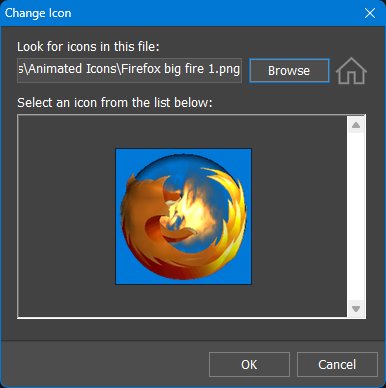
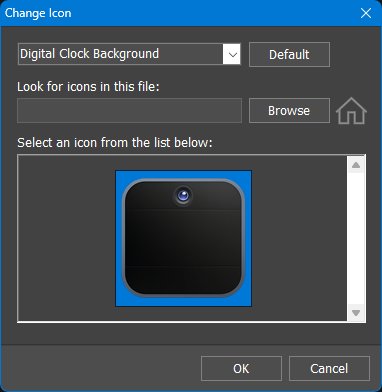
Change Icon dialog
The normal Change Icon dialog lets you browse for a different icon source and then select the icon or image to assign to the Dock item.
Look for icons in this file. Shows the current icon source. This can be an executable or other file containing icon resources, or a supported image file such as PNG, ICO, TIF, or WebP.
Browse. Opens the file browser so you can select a different icon source.
Home folder button. Selecting the small house symbol changes the Browse button's home location to the Winstep Icon Samples folder. Clicking Browse afterwards therefore opens directly in the sample-icon collection installed with Winstep.
Icon list. Displays the icons or image found in the selected source. Select the desired image and click OK to assign it to the Dock item.
An animated PNG strip can be selected through this dialog just like another image. Once Nexus recognizes the strip as an animated icon, the Animation button in Item Properties can be used to configure its playback behavior.
Module icon backgrounds
Iconic modules are different from ordinary shortcut icons because the module draws live information on top of its icon artwork. For most modules, the module version of the Change Icon dialog therefore lets you choose a custom background image for the iconic module instead of simply replacing the whole module with a static icon.
Changing an iconic module background item-properties-change-icon-module.jpg
Module style selector. Nexus modules provide two iconic styles. Where the selected module supports custom backgrounds, the selector at the top lets you choose which style's background is being changed. The Clock module, for example, can have one custom background for its Analog Clock style and a different background for its Digital Clock style.
Default. Restores the default artwork for the currently selected module style.
Custom module backgrounds. Any replacement background must be designed with the module's live overlay in mind. Nexus continues to draw the module's information - such as clock hands, digits, meters, indicators, or text - over the selected background. A good custom background therefore needs to leave the appropriate areas clear and visually compatible with the information that the module draws on top of it.
4.4 Regular items versus live folder views
A regular Dock item stores a Nexus item such as an application shortcut, document shortcut, folder shortcut, module, internal command, separator, or task-related item. Removing a regular shortcut from the Dock normally removes only the Dock item, not the original file or application.
Folder browse menus and some shell views are live views into actual folders or virtual shell locations. Adding, renaming, moving, or deleting items there may affect the underlying Windows files, folders, or shortcuts. Treat those views with the same care as Explorer windows.
4.5 Manual ordering and sort options
Normal Dock items can be rearranged manually by dragging them into the desired order.
Folder browse menus and live shell views may instead provide Sort options. Folder-type contents can be sorted by name, creation date, modification date, file extension or type, and file size where supported.
4.6 System and virtual folder access
Nexus Dock items can point to normal folders, Windows special folders, Control Panel items, documents, URLs, applications, and other shell objects. These items behave like shortcuts: clicking them opens the target, while right-clicking them can show both Nexus item commands and the Windows shell context menu for that target.
4.7 Browsing folder shortcuts through menus
A folder shortcut in the Dock can be browsed through a pop-up menu instead of being opened in Explorer. This is useful when you want to see many items at once without opening a separate Explorer window.
This behavior can be made the default left-click action for that folder by enabling Show Folder in a Menu in the folder item's Properties dialog. When the folder-menu mouseover option is enabled, the same menu can also open automatically after the pointer hovers over the folder item for the configured delay. When browsing folders through menus, documents can show a thumbnail next to the menu when the mouse pointer pauses over them.
Folder browse menus can be sorted by right-clicking an item in the browse menu. Available sort choices include name, type, date created, date modified, and file size.
4.8 Selection and item manipulation
Dock items can be dragged, reordered, copied, removed, customized, and edited through their context menus and Properties dialogs. Where a Nexus view supports multiple selection, you can use selection rectangles, Shift, Ctrl, and Ctrl+A to manipulate more than one item at the same time.
Be careful in live folder views: deleting or moving items there can affect the actual files or shortcuts, not only visual entries.
4.9 Modern applications, PWAs, shortcuts, and item images
Items can use normal static icons, high-resolution image files, and supported animated icon strips. Current versions can also use WebP images directly as item icons. This matters when building polished workspaces: you can match shortcuts to a theme, replace low-resolution icons, or use animation only where it adds useful feedback.
Supported Progressive Web Apps installed through Chrome, Brave, Microsoft Edge, or Vivaldi can be pinned, launched, and managed like native desktop applications instead of being lumped together as generic browser windows. Grouped PWA task items use the application name rather than the browser name, and a default PWA icon is used when no suitable application icon is available.
Nexus does not treat modern Windows applications as second-class shortcuts. UWP apps can be added to the Dock and managed alongside traditional desktop applications where Windows exposes the required application information.
4.10 Keyboard navigation and remote-control use
Keyboard navigation is also an accessibility and convenience feature. It allows users to activate the Dock, move through its items, and launch what they need even when precise mouse control is inconvenient.
The Dock can be brought forward and used from the keyboard through hotkeys and keyboard navigation, making it suitable for home-theater setups, couch use, or remote-control devices such as Logitech Harmony remotes.
4.11 Document thumbnails and thumbnail file types
Documents displayed in the Dock or in folder browse menus can show a thumbnail when Windows or Nexus can generate one. This makes image files, documents, and other visual content easier to identify at a glance than a generic file-type icon.
The list of file extensions that receive thumbnail treatment can be edited in the Thumbnail File Types dialog, available from the More Options dialog in the General tab of Preferences.
4.12 Dock item drag & drop
Drag and drop works both into and out of the Dock. You can drag files, folders, shortcuts, URLs, images, printers, and other objects from Explorer or the Desktop into the Dock; you can also drag items back out to Explorer folders or to the Desktop.
If a dropped shortcut needs to remain a shortcut file instead of being resolved to its target, hold Alt while dropping it. This is useful in unusual cases such as 64-bit redirection issues or shortcuts whose own Start in folder must be preserved exactly.
4.13 Fast icon customization by drag & drop
Icons can be customized very quickly by dragging an image file directly onto a Dock item icon. Supported image formats include PNG, ICO, TIF, and WEBP. This allows you to open an Explorer folder containing favorite icons and customize many Dock items simply by dropping each image onto the item it should replace.
This is often much faster than opening the Properties dialog for each item individually, especially when building a themed Dock, replacing imported shortcut icons, or customizing a group of project shortcuts.
4.14 Dropping documents onto application items
Application items in the Dock support document drag & drop. Dropping a document onto an application item opens that document with the application. For example, dropping a text file onto a Notepad shortcut launches Notepad with that document; dropping an image onto an image editor opens the image in that editor.
Documents can also be routed to applications that are already running. Drag a document over a running task icon and pause briefly to bring the associated window to the foreground, then drop the document into that window. If the icon represents a grouped task, hovering over the grouped icon first opens the live thumbnails; hovering over the desired thumbnail can then bring that specific window forward.
5. Nexus Preferences
The Nexus Preferences dialog is the central configuration window for the free
version of Nexus.
The tabs are shown in the same order as the dialog itself: Content, Modules, Position, Behavior, Appearance, Effects, Themes, Sounds, Tasks, General, Advanced, and About.
Command buttons. Use Preview to see the effect of changes before saving them; OK to save changes and close; Cancel to close without applying changes; Help to open the User Guide for the current area.
5.1 Content tab
Preferences - Content tab nxcontent.jpg
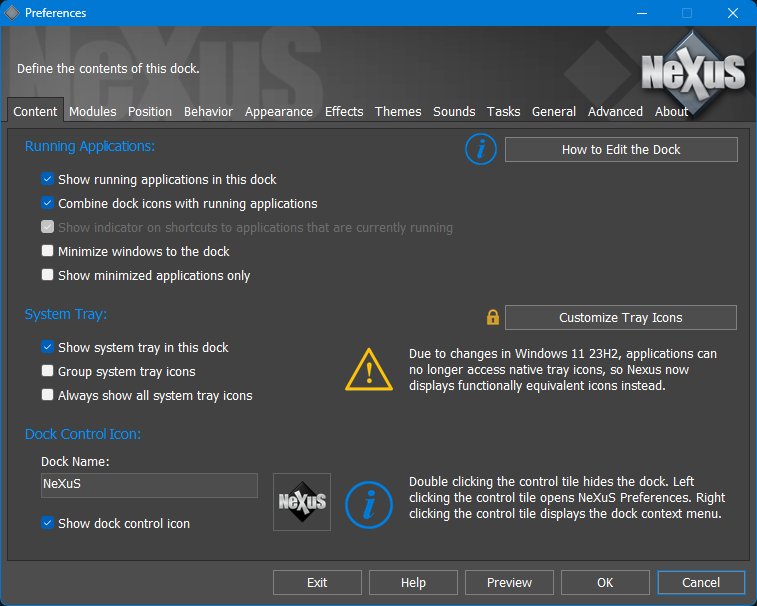
The Content tab defines what the Dock displays in addition to the user-created items already placed in the Dock.
Show running applications in this dock. Displays running tasks in the Dock. This lets the Dock act as both a launcher and a task switcher.
Show indicator on shortcuts to applications that are currently running. Adds a running indicator to Dock shortcuts when the corresponding application is already active.
Show system tray in this dock. Displays system tray icons in the Dock.
Group system tray icons. Groups tray icons together instead of showing each tray icon as a separate Dock item.
Always show all system tray icons. Forces all tray icons to be visible in the Dock rather than following normal hidden/visible tray behavior.
Dock Name. Gives the Dock a name for identification. This is useful when managing a single Dock from Preferences.
Dock Control Icon. The control tile provides quick access to Preferences and Dock commands. The screenshot note reminds the user that double-clicking the control tile hides the Dock, left-clicking opens Preferences, and dragging the control tile can move or manipulate the Dock depending on context.
5.2 Modules tab
Preferences - Modules tab nxmodules.jpg
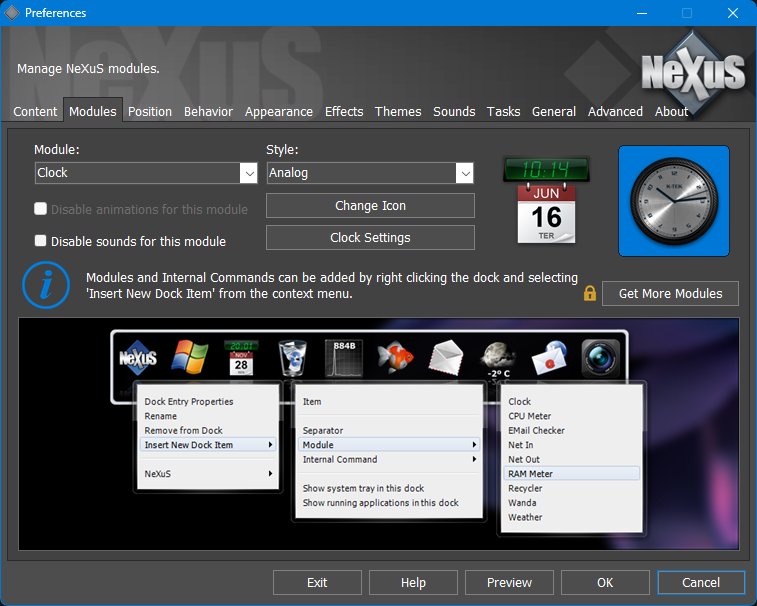
The Modules tab manages global settings for Nexus modules. Modules are built-in mini-applications that can appear in compact iconic form on the Dock. The free version of Nexus includes the supported modules documented in this guide, such as Clock, Recycler, CPU Meter, RAM Meter, Net Meter, Email Checker, Weather, and Wanda.
All supported modules provide two icon styles for iconic presentation, and some styles can be further customized through user-provided background images or icons.
Module resource usage. Modules do not run in the background unless they are actually being used. A module is considered active if it is shown in iconic form on the enabled Dock. If a module is not active anywhere, it uses no resources. For example, Nexus only measures network activity when a Net Meter module is active.
Module selector. The module drop-down selects which module is being configured. The preview and options below update to match the selected module.
Icon Style. All supported modules provide exactly two icon styles. The selector chooses which style is used for the selected module in iconic form. For some styles, you can also change the background image or icon used by that style. Use the Change Icon button in the Modules tab, or the Change Icon button in the module item's Properties dialog, to select a different image.
Disable animations for this module. Turns off animations for the selected module only. This can reduce motion or lower overhead while leaving animations enabled elsewhere.
Disable sounds for this module. Prevents the selected module from playing module-specific sounds.
Settings / More Options / Change Icon. These buttons open the selected module's own configuration dialog, additional module options, or icon customization.
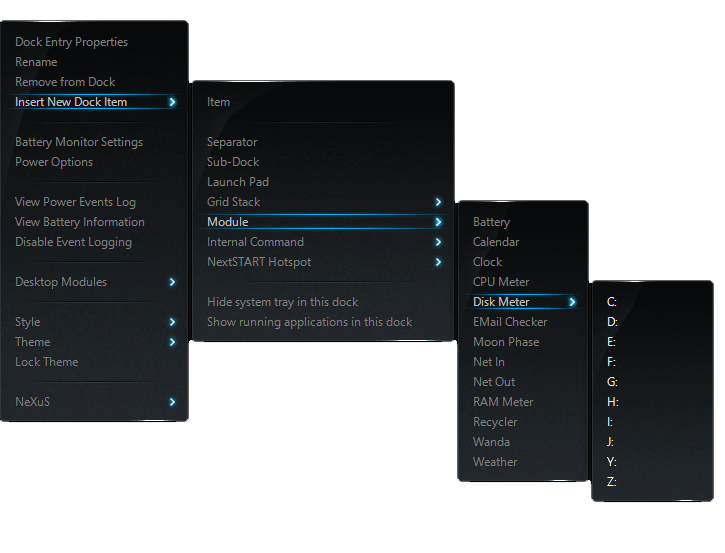
Module insertion. Modules can be inserted from Dock context menus as well as through item properties. Right-click the Dock or a Dock item area, choose the insert command, and select Module.
5.3 Position tab
The Dock can also reserve or respect screen space, auto-hide, or use Dodge Windows behavior so they stay visible until the active window would cover them. These options are different ways of balancing access and screen real estate: reserve space when the dock should always remain unobstructed, normal auto-hide when you want maximum screen space, and Dodge Windows when you want the dock visible except when it actually gets in the way.
Preferences - Position tab nxposition.jpg
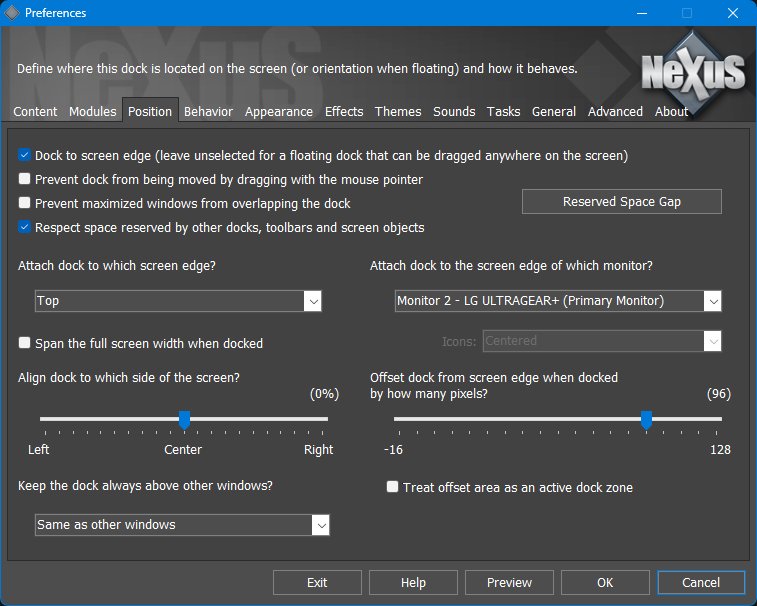
The Position tab controls where the Dock appears, whether it is docked or floating, how it aligns to the screen edge, and how it interacts with other windows and reserved screen areas.
Dock to screen edge. Attaches the Dock to a screen edge. Leave this option unselected to use the Dock as a floating Dock that can be dragged anywhere on the desktop.
Prevent dock from being moved by dragging with the mouse pointer. Locks the Dock position so it cannot be accidentally dragged to a new location.
Prevent maximized windows from overlapping the dock. Reserves space so maximized windows do not cover the Dock. This is most useful when the Dock should remain visible while working.
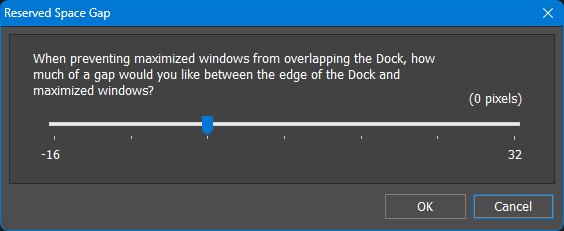
Reserved Space Gap. Opens a dialog where you can set the gap, in pixels, between the Dock and maximized windows when Prevent maximized windows from overlapping the dock is enabled.
Respect space reserved by other toolbars and screen objects. Makes the Dock take existing reserved screen space into account, such as the Windows taskbar or other screen-edge objects.
Attach dock to which screen edge? Selects the edge used by a docked Dock. For a horizontal Dock this is normally top or bottom; for a vertical Dock it is left or right.
Attach dock to the screen edge of which monitor? Selects the monitor used by the Dock in multi-monitor systems.
Span the full screen width when docked. Extends the Dock background across the full width or height of the screen edge while keeping the icons aligned according to the Dock alignment setting. Tile-based themes cannot be stretched this way; enabling the option with such a theme displays a warning explaining that a single continuous Dock background is required.
Docked, non-tiled Dock backgrounds can optionally span the full width of the screen for a horizontal Dock or the full height of the screen for a vertical Dock. The icons remain dock icons rather than taskbar buttons, but the extended background can make the dock feel visually integrated with the screen edge. A floating Dock or a Dock using a tiled background keeps its normal background behavior.
Align dock to which side of the screen? Aligns the Dock along the selected edge. For a horizontal Dock this corresponds to left, center, or right alignment; for a vertical Dock the equivalent choices are top, center, or bottom.
Offset dock from screen edge. Moves the Dock away from the screen edge by the selected number of pixels.
Treat offset area as an active dock zone. Allows the offset area between the Dock and the screen edge to behave as part of the Dock activation zone.
When a dock is attached to a screen edge but offset away from that edge, the gap between the dock and the edge may optionally be treated as part of the dock's active zone. This makes the dock easier to hit with the mouse, similar to edge-based dock behavior, but it also means normal clicks in that gap are intercepted by the dock. Use it only when the gap is intended to behave as dock territory.
Keep the dock always above other windows. Controls the Dock's z-order behavior. A Dock can behave like a normal window, remain always on top, or remain always on bottom, depending on the selected mode.
Bring dock forward when the mouse pointer bumps screen edge. For an always-on-bottom Dock, temporarily brings the Dock to the top of the z-order when the mouse pointer bumps the associated screen edge, allowing the Dock to be accessed without changing its normal z-order mode.
Reserved-space gap
The Reserved-space gap dialog controls the gap between the dock and maximized windows when Prevent maximized windows from overlapping the
dock is enabled. The value is measured in pixels. Positive values leave extra space between the
dock and maximized windows, while negative values allow maximized windows to move closer to, or slightly under, the
dock's edge.
Edge Gap nxedgegap.jpg
Dock and Dock themes often include drop shadows, glow effects, or semi-transparent borders around the main body. Although these pixels are technically part of the object, they can create the impression that maximized windows stop too far away from the visible edge. This setting lets you compensate for that by using a small negative value, or deliberately leave extra breathing room with a positive value. The value is measured in pixels and has a small range because it is intended only for fine-tuning the reserved space.
5.4 Behavior tab
Preferences - Behavior tab nxbehavior.jpg
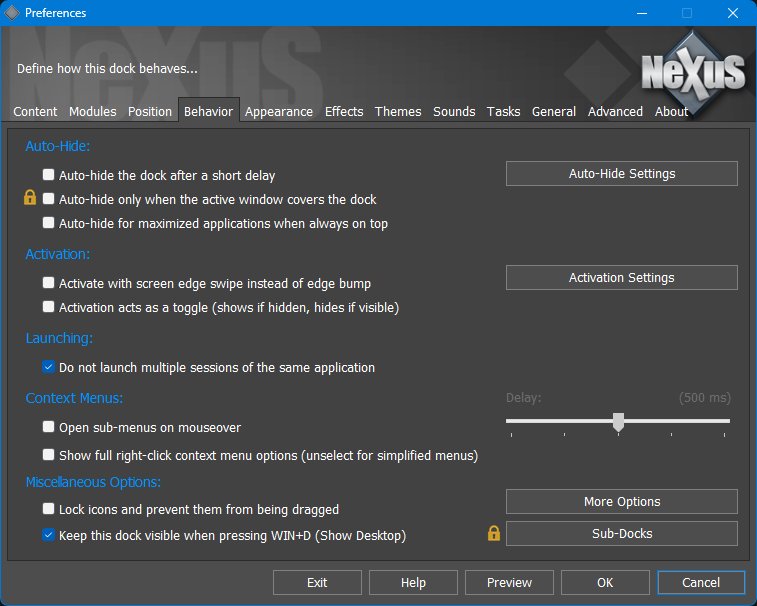
The Behavior tab controls how the Dock hides, activates, launches items, displays context menus, and handles dragging or desktop interactions.
Auto-hide the dock after a short delay. Enables normal time-based auto-hide. The Dock hides or collapses automatically after the configured delay when the pointer leaves or the Dock is no longer active. The detailed timing and animation are configured in Auto-Hide Settings.
Auto-hide only when the active window covers the dock. Enables Window Dodge mode. Instead of hiding after a fixed delay, the Dock hides only when the active window overlaps or covers the Dock area
and shows up again when the window moves away. This keeps the Dock visible while there is room for it, but moves it out of the way when the current window needs the same screen space.
Auto-hide mode selection. Normal time-based auto-hide and Window Dodge mode are mutually exclusive. Selecting one automatically clears the other.
Auto-hide for maximized applications when always on top. Allows an always-on-top Dock to hide automatically when a maximized application would otherwise conflict with it.
Activate with screen edge swipe instead of edge bump. Uses an edge swipe gesture instead of a simple edge bump to activate the Dock.
Activation acts as a toggle. Makes activation show the Dock when hidden and hide it again when visible.
Do not launch multiple sessions of the same application.
Prevents launching another instance when an application of the same
executable, UWP app, or PWA is already running. This behavior can be
overridden per item in the item's Properties dialog, or temporarily bypassed
by launching the item with the middle mouse button instead of the left mouse
button.
Open sub-menus on mouseover. Opens submenus automatically when the pointer rests on a submenu item. When disabled, the user must click to open the submenu.
Delay before automatically opening sub-menus. Controls the hover delay used when submenus open on mouseover.
Show full right-click context menu options. Controls whether file-based Dock items show only Nexus commands or also include the Windows shell context-menu commands for the target file, folder, shortcut, or application. When enabled, right-click menus may include Explorer-style options such as Open, Send To, Copy, Properties, and commands added by third-party shell extensions, making the menu longer.
Lock dock items to prevent them from being dragged. Prevents accidental rearranging or removal of Dock items by drag and drop.
Keep this dock visible when pressing WIN+D. Keeps the Dock visible when Windows Show Desktop is used.
The buttons on this page open related dialogs for Auto-Hide Settings, Activation Settings
and More Options.
Auto Hide Settings
Dock Auto Hide Settings nxautohide.jpg
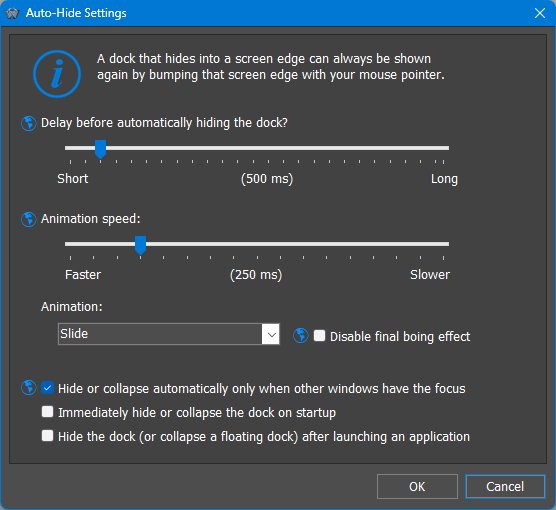
Auto Hide Settings control the delay, animation speed, animation style, and startup behavior used when the Dock hides into a screen edge or a floating Dock collapses.
Delay before automatically hiding the dock. Sets how long the Dock waits before hiding or collapsing after the pointer leaves or activity stops.
Animation speed. Controls how quickly the hide/show animation runs.
Animation. Selects the animation style, such as Slide,
Fade Out, Fly Out, Burn, Flare, Implode.
Disable final boing effect. Removes the final bounce/elastic effect at the end of the hide/show animation.
Hide or collapse automatically only when other windows have the focus. Prevents automatic hiding/collapsing while the Dock itself is the active object.
Immediately hide or collapse the dock on startup. Starts the Dock already hidden/collapsed.
Hide the dock after launching an application. Hides or collapses the Dock after an item is launched.
Activation Settings
Dock Activation Settings nxactivation.jpg
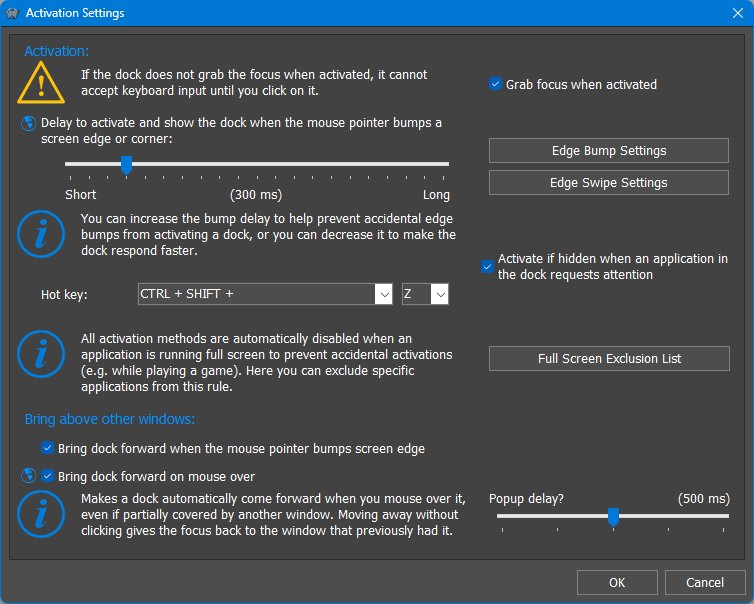
Activation Settings define how a hidden or covered Dock is brought forward or shown.
Grab focus when activated. Allows the Dock to accept keyboard input immediately after activation.
Edge bump or edge swipe activation. Sets the delay and behavior used when the pointer bumps or swipes the screen edge or corner associated with the Dock.
Activation method. Selects the method used to activate the Dock. This can be a keyboard shortcut, a screen-corner bump, a screen-edge bump
or a screen-edge swipe. When a keyboard modifier combination is selected, the adjacent key selector completes the hotkey.
Activate if hidden when an application in the dock requests attention. Shows or activates the Dock when one of its represented applications needs attention.
Full-screen exclusion list. Activation methods are automatically disabled while full-screen applications are running to avoid accidental activations, such as during games. The exclusion list allows specific applications to be excluded from this rule.
Bring dock forward when the mouse pointer bumps screen edge. For an always-on-bottom Dock, temporarily brings the Dock to the top of the z-order when the mouse pointer bumps the associated screen edge, allowing the Dock to be accessed without changing its normal z-order mode.
Bring dock forward on mouse over. Temporarily brings the Dock to the front when the mouse pointer moves over it after the configured popup delay. This is useful when another window is partly covering the Dock but some part of the Dock is still reachable. If you move the pointer away without clicking the Dock, the previously foreground window is brought back to the front, so the Dock does not permanently steal focus or change the window order.
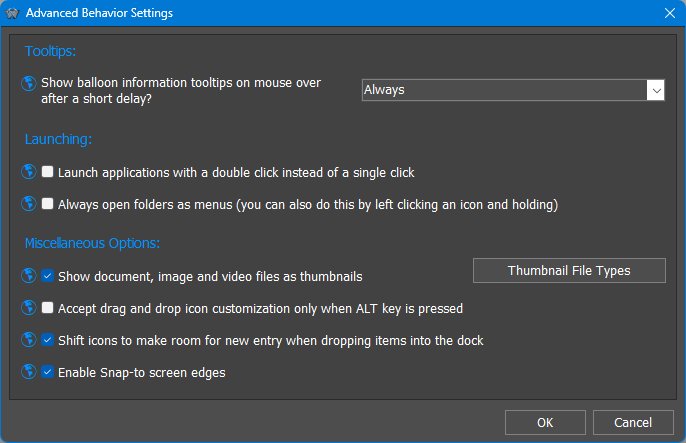
Advanced Behavior Settings
Dock Advanced Behavior Settings nxadvancedbehavior.jpg
Open folder menus on mouseover. Opens folder shortcuts configured to show as menus when the pointer remains over them. The accompanying popup-delay setting controls how long the pointer must hover before the folder menu opens.
Show balloon information tooltips on mouse over after a short delay? Controls when balloon information tooltips are shown after the pointer rests over an item. Choose Never, Always, Only for Modules, or Only for Modules and Documents. Module tooltips can show module-specific status information, while document tooltips can provide additional file information where available.
Launch applications with a double click instead of a single click. Changes Dock launching behavior for users who prefer double-click activation.
Always open folders as menus. Opens folder shortcuts as menus by default instead of opening them normally. The same behavior can also be invoked temporarily by left-clicking and holding a folder icon. If this global option is disabled, you can still enable the behavior for individual folder shortcuts by enabling Show folder in a menu in that folder shortcut's Item Properties dialog.
Show document, image and video files as thumbnails. Displays supported files as thumbnails instead of generic icons.
Accept drag and drop icon customization only when ALT key is pressed. Requires the ALT key to be held before a dropped ICO, PNG, TIF, or WEBP image can replace the icon of a Dock item. This prevents ambiguity when dropping image files onto application shortcuts. For example, dropping a PNG file onto a Photoshop shortcut can open the image in Photoshop; holding ALT while dropping the same file tells Nexus to use it as a replacement icon instead.
Shift icons to make room for new entry when dropping items into the dock. Automatically opens space for dropped items during drag and drop.
Enable Snap-to screen edges. Automatically docks a floating Dock when it is dragged to a screen edge. If the mouse pointer touches the edge while dragging the Dock, the Dock snaps to that edge and becomes docked there.
5.5 Appearance tab
Dock appearance is not limited to static icons. The Dock can use live icon reflections that update as icons change, animated icons for supported image-strip formats, and visual effects that respond to mouseover, launch, attention, deletion, or dragging.
General item-image replacement by dropping PNG, ICO, TIF, or WebP files onto items is described in Working with Dock Items.
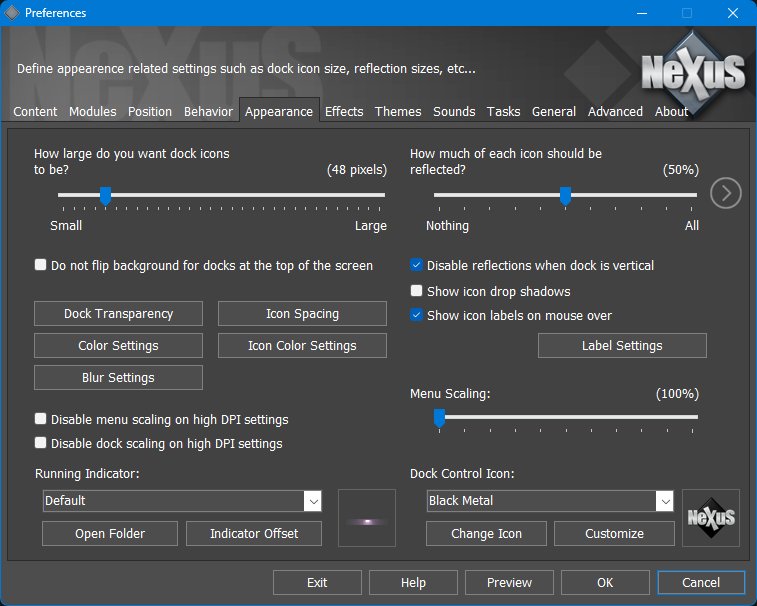
Preferences - Appearance tab nxappearance.jpg
The Appearance tab controls Dock icon size, reflections, transparency, labels, indicators, control icon, scaling, and related visual options.
Icon size. Sets the normal size of Dock icons. The Dock may reduce icon size automatically when necessary so that all items can fit on screen.
Minimum icon size is 16 pixels and maximum icon size is 256 pixels.
Icon reflection size. Controls how much of each icon is reflected. The gray arrow/page switcher in the lower-right corner accesses reflection transparency
settings.
Do not flip background for docks at the top of the screen. Prevents the Dock background from being flipped when the Dock is attached to the top edge.
Disable reflections when dock is vertical. Turns off icon reflections when the Dock is vertical.
Show icon drop shadows. Adds a shadow below Dock icons.
Show icon labels on mouse over. Displays item labels when the pointer is over Dock icons. The Label Settings button controls label font, effects, background, and colors.
Dock Transparency. Opens Dock transparency settings.
Icon Spacing. Opens horizontal and vertical spacing controls.
Color Settings / Icon Color Settings. Opens colorization controls for the Dock background or icons.
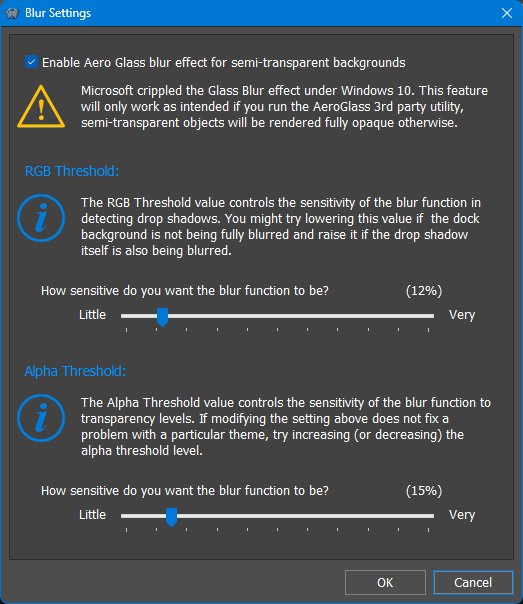
Blur Settings. Controls blur-behind behavior for compatible transparent Dock backgrounds.
Menu Scaling and Dock Scaling. Controls high-DPI scaling exceptions for menus and the Dock.
Running Indicator. Selects the image used as the Dock's running/open indicator. The entries in this combo box are loaded from the running indicators folder and are shown as filenames without their file extensions.
Open Folder. Opens the folder where running indicator images are stored. Add or remove indicator images in this folder to make them available in the Running Indicator combo box.
Indicator Offset. Adjusts the position of the selected running/open indicator relative to the Dock icons.
Dock Control Icon. Selects the Dock control icon used by this Dock. The drop-down includes several built-in Nexus icon color presets, plus options for a user-defined color or a user-defined icon.
Change Icon. Lets you replace the Dock control icon with your own image file. Supported formats include ICO, PNG, TIF, and WEBP.
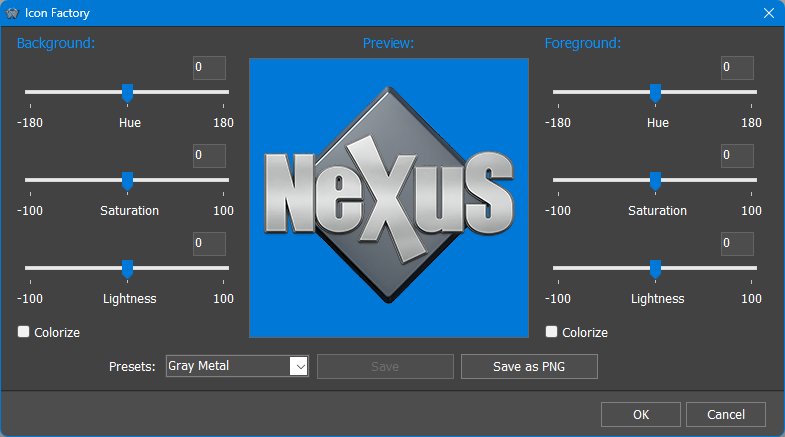
Customize. Opens the Icon Factory dialog for the Nexus control icon. The Nexus icon is made from
two separate elements, the background shape and the Nexus word, so each part can be colorized independently. Use this when you want a custom color combination different from the built-in color presets .
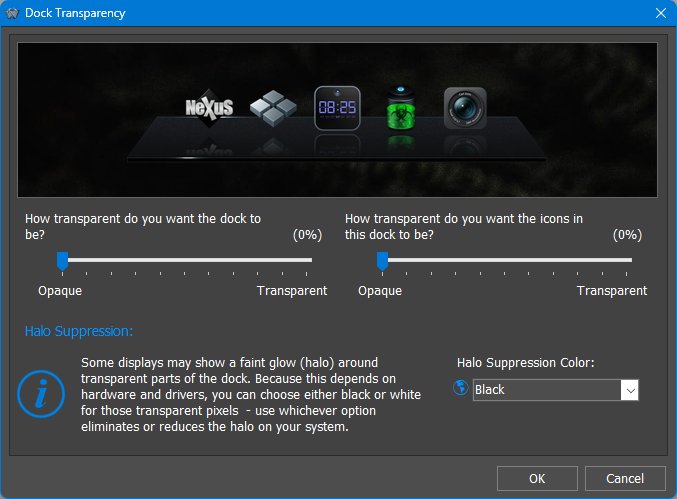
Transparency
Dock Transparency Settings nxtransparency.jpg
The Transparency dialog controls separate transparency levels for the Dock background and Dock icons. It also includes halo suppression settings for systems where transparent pixels show a faint glow around the Dock.
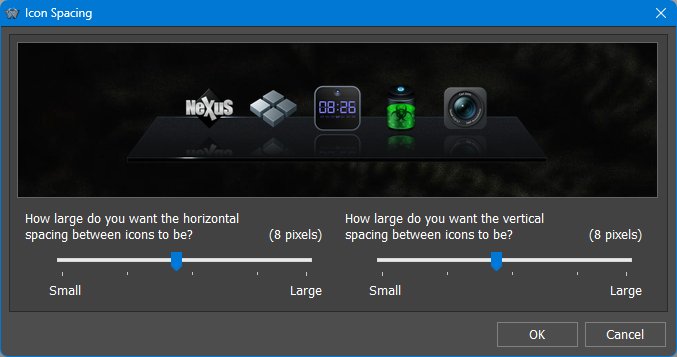
Icon Spacing
Dock Icon Spacing nxiconspacing.jpg
The Icon Spacing dialog provides two sliders: horizontal spacing between icons and vertical spacing between icons. Both values are measured in pixels and can be adjusted from 1 to 64 pixels. If excessive spacing would make the Dock extend beyond the available screen area, Nexus may reduce the icon size, down to its minimum, to keep the Dock on screen.
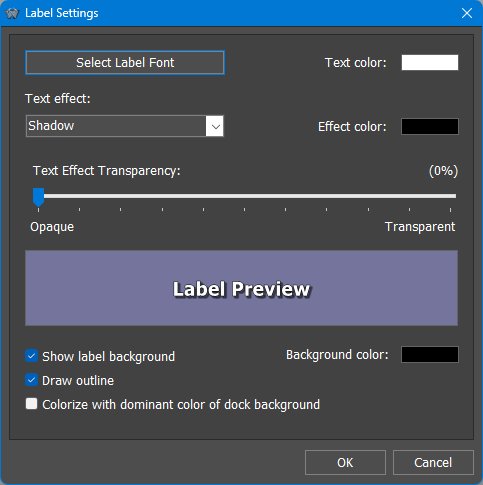
Label Settings
Dock Label Settings nxlabelsettings.jpg
Label Settings control the appearance of mouseover labels, including the label font, text color, text effect, effect color, text effect transparency, optional label background, outline, background color, and whether the label is colorized with the dominant color of the Dock background.
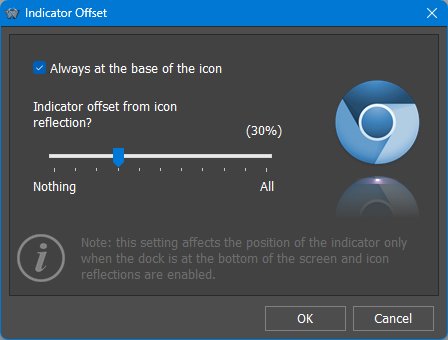
Indicator Offset
Dock Indicator Offset nxiindicatoroffset.jpg
The Indicator Offset dialog adjusts where running/open indicators appear relative to the Dock icon and icon reflection. The dialog notes that this setting affects indicators at the top or bottom of the screen and is not relevant for a side-attached Dock.
Icon Factory
Icon Factory nxiconfactory.jpg
The Icon Factory dialog provides hue, saturation, and lightness adjustments for colorizing
the Dock control icon, with presets and a live preview.
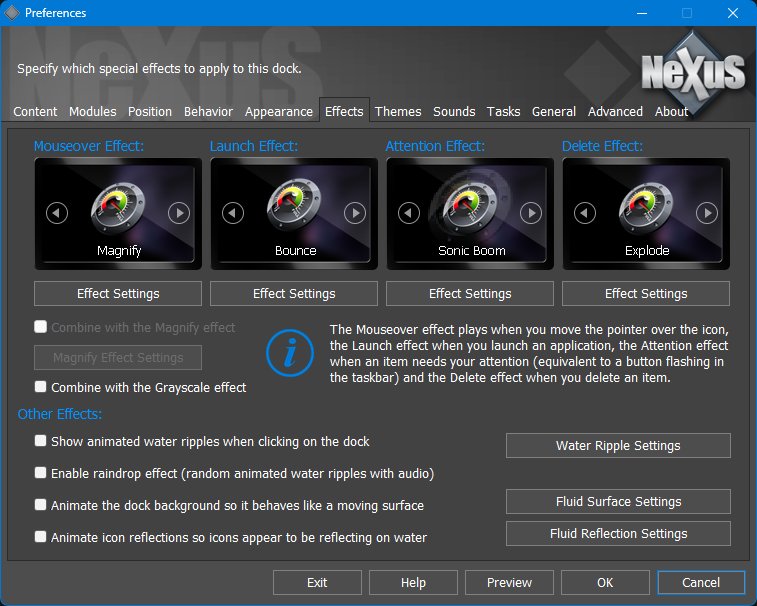
5.6 Effects tab
Preferences - Effects tab nxeffects.jpg
The Effects tab controls animated feedback for mouseover, launch, attention, deletion, and background/reflection effects.
Mouseover Effect. Plays when the pointer moves over an icon. Effects can be combined with magnification
and grayscale where supported.
Launch Effect. Plays when launching an item.
Attention Effect. Plays when an item needs attention, similar to a flashing taskbar button.
Delete Effect. Plays when deleting an item from the Dock.
Effect Settings. Opens settings for the selected effect type.
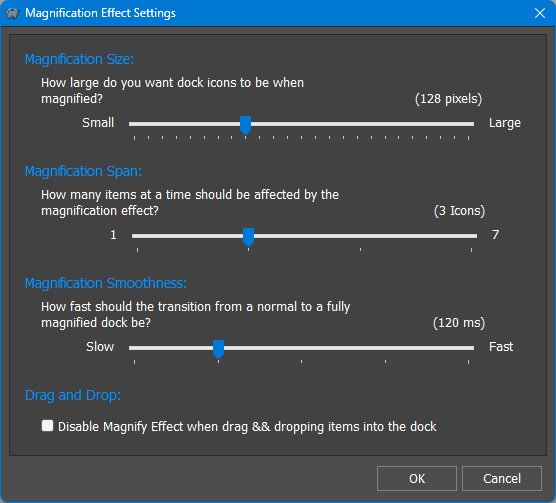
Magnify Effect Settings. Opens the magnification settings dialog when magnification is enabled or combined with another mouseover effect.
Water Ripple. Shows animated water ripples when clicking the Dock.
Raindrop effect. Adds random animated water ripples with audio.
Fluid Surface. Animates suitable Dock backgrounds so they behave like a moving surface.
Fluid Reflection. Animates icon reflections so they appear to reflect on water or another moving surface.
Dock Magnify Effect Settings nxfxmagsettings.jpg
Magnify Effect Settings control the magnified icon size, the magnification span, transition smoothness, and whether magnification is disabled while drag-and-dropping items into the Dock.
Effect-specific settings
Many effects have their own settings, available through the Effect Settings button next to the selected effect. These settings can dramatically change the character and impact of an effect, so it is worth adjusting them instead of judging an effect only by its default preview. Depending on how the effect is generated, the dialog provides settings for either a physical effect or a particle effect.
Physical effects can be adjusted through Magnitude and Duration.
Physical effects. Effects based on movement or deformation, such as Push, provide Magnitude and Duration settings. Magnitude controls the strength or extent of the movement, while Duration controls how quickly the animation completes. A short, low-magnitude effect can feel subtle and responsive; increasing either value can make the same effect much more pronounced.
Particle effects can use their original colors, a chosen color, or the dominant color of the icon.
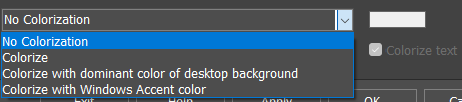
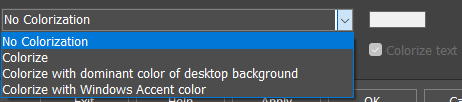
Particle effects. Effects made from animated particles, such as Demolish, provide colorization options as well as Duration. No Colorization uses the effect's original colors. Colorize applies a color selected by the user. Color Hot-Track automatically uses the dominant color of the icon, in much the same way as the glow effect used by buttons on the Windows 7 taskbar. This can produce especially attractive results because the particles visually match each icon. Duration controls how long the particle animation remains visible.
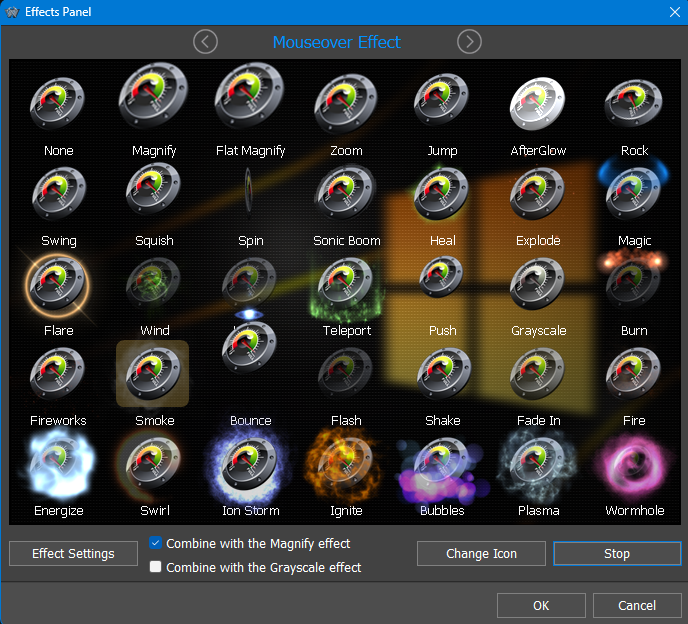
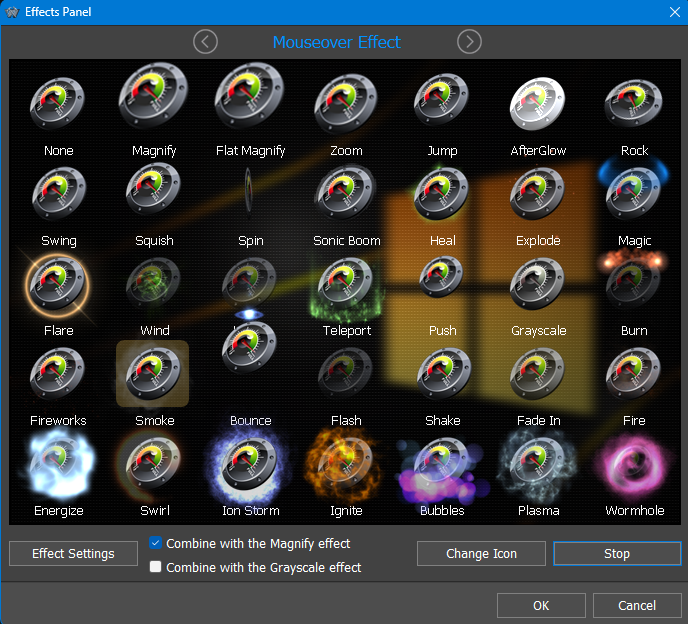
Effects Panel preview
Clicking an effect icon opens the Effects Panel, where available effects can be previewed together and combined with supported effects such as Magnify or Grayscale.
The Effects tab uses icons to represent each available effect. Clicking the effect icon opens the Effects Panel, which shows the available effects and lets the user preview them. This is much more useful than choosing from a plain list because effects such as Magnify, Jump, AfterGlow, Rock, Swing, Spin, Teleport, Fireworks, Smoke, Bubbles, Plasma, and others are best understood visually.
Some effects can be combined with Magnify or Grayscale, allowing the Dock to keep its normal magnification behavior while adding an additional visual response. Effects are not only decorative: they provide immediate feedback for mouseover, launch, attention, delete, and other actions.
Effects as feedback, not just decoration
Effects help communicate what is happening: mouseover effects show which item is active, launch effects confirm that a command was triggered, attention effects replace or supplement taskbar flashing, and delete effects provide visual confirmation when an item is removed. Fluid, ripple, and reflection effects are optional polish and can be disabled or reduced through Effects, Performance, or Power Saving settings.
On laptops or low-power systems, effects should be balanced against battery life and responsiveness. Normal and Ultra Power Saving modes automatically reduce or disable many animations, including dock hide/show animations, water effects, animated icons, and repeated effect timing.
5.7 Themes tab
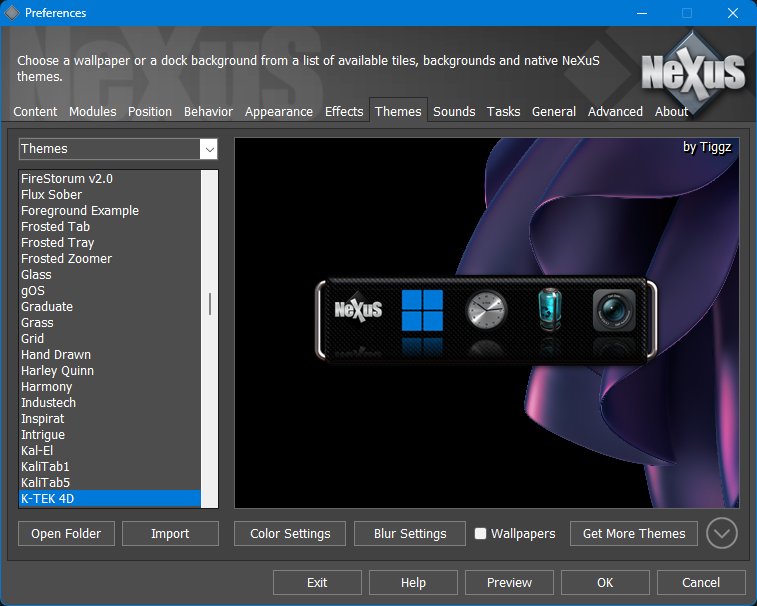
The Themes tab chooses the Dock background, tiles, wallpapers, and native Nexus themes used by the Dock. It is also where you import additional themes, open the theme folder, adjust colorization and blur settings, and get more themes online.
Preferences - Themes tab nxthemes.jpg
Theme/resource selector. The drop-down at the top selects which visual resources are being displayed, such as native Nexus themes, Dock backgrounds, tiles, or wallpapers.
Theme/resource list and preview. The list shows the available resources for the selected category. Selecting one displays it in the preview area so you can inspect it before applying or using it.
Wallpapers. When enabled, theme-provided wallpapers are included so a Dock theme can also apply its matching desktop wallpaper.
Open Folder. Opens the folder containing the currently selected theme. This is useful when you want to inspect or manually edit the bitmaps, configuration files, or other resources that belong to that theme.
Import. Imports a theme package or skin. Older themes are usually stored as .zip files and are imported from this tab. Newer self-installing .xtreme theme packs can also be installed by double-clicking them. You can also place multiple theme packs in the Winstep AutoInstall folder and import them together.
Get More Themes. Opens the Winstep themes page or online theme source in your default browser, where additional Winstep themes can be downloaded.
Delete. Deletes the currently selected theme after confirmation. Theme files are moved to the Recycle Bin, so they can normally be restored from there if you change your mind.
Color Settings. Opens global colorization settings for the currently selected theme category or object type. Theme colorization can quickly create many color variations from the same base artwork. The gray arrow in theme-related tabs can also switch to colorization options where available
so you can preview the changes immediately.
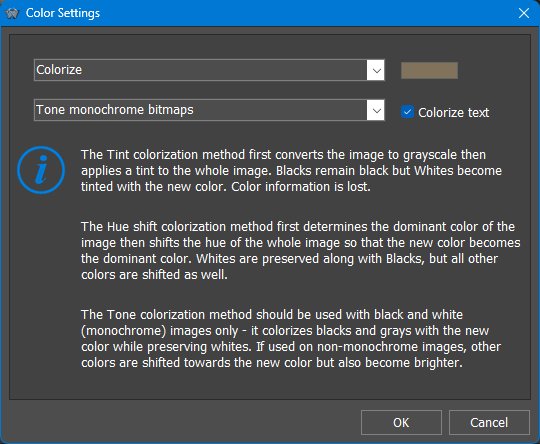
Theme colorization dialog wscolorize.jpg
Colorization methods. Theme colorization can tint, hue-shift, or tone images depending on the selected method. Tint converts the image to grayscale before applying the selected color. Shift Hues changes the dominant color while preserving black, white, and much of the original shading. Tone Monochrome Bitmaps is intended mainly for monochrome or grayscale artwork.
Blur Settings. Opens global blur-behind settings for semi-transparent backgrounds. These settings apply to the currently selected theme category or object type. To apply the same blur and colorization settings broadly, use the appropriate Apply to All option where available.
Blur Behind settings wsblurbehind.jpg
Installing themes and 3rd party dock skins
Winstep themes and Nexus dock skins can be installed in several ways, depending on the file format and how the theme author packaged the download.
Self-installing themes. Some Winstep themes are distributed as .xtreme files. To install one of these themes, double-click the file. The theme is automatically added to the list of available themes.
ZIP themes and skins. Older Winstep themes and many 3rd party dock skins are distributed as .zip files. In most cases, open the Themes tab in Preferences, click Import, browse to the downloaded ZIP file, and open it. The imported theme or skin should then appear in the appropriate theme list.
ZIP file contents can vary. Theme authors do not always package ZIP files the same way. Some ZIP files contain the theme bitmaps and configuration files directly, while others contain one or more folders or several variations of the same theme. If a ZIP file does not import as expected, open it and check its contents. Folder-based themes may need to be copied manually into the Themes folder inside the Winstep user data folder.
3rd party dock skins. Nexus can import many dock skins originally made for ObjectDock, RocketDock, RK Launcher, MobyDock, and Y'z Dock. These skins are non-native Nexus skins and are stored separately from native Winstep themes.
Installing several themes at once. Downloaded ZIP and Xtreme theme files can be placed in the Winstep AutoInstall folder and installed together. Files in this folder are processed when you click Import or when Nexus/Winstep starts.
AutoInstall warning. ZIP and Xtreme theme files placed in the AutoInstall folder are deleted automatically after installation. Keep backup copies of downloaded theme files elsewhere if you want to preserve the originals.
5.8 Sounds tab
Preferences - Sounds tab nxsounds.jpg
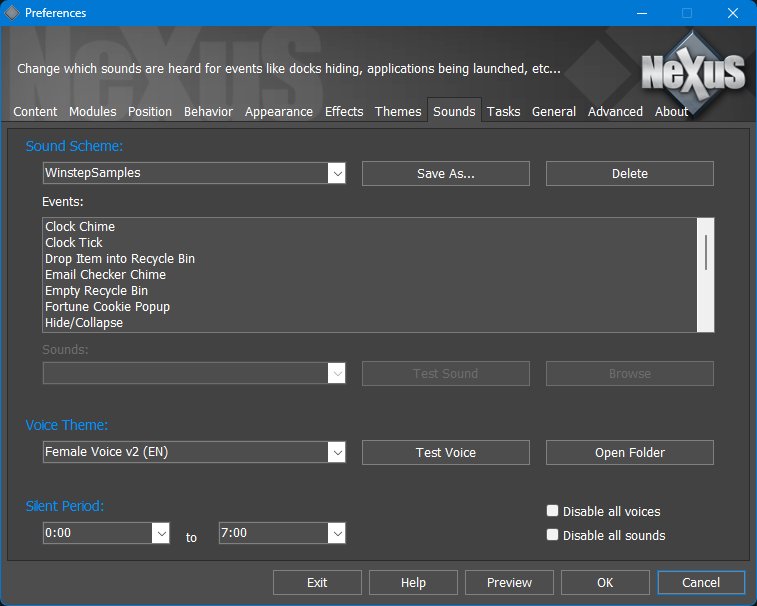
The Sounds tab controls global sound effects and voice files. Sound schemes provide event sounds, while voice themes provide spoken announcements used by modules.
Sound Scheme. Selects the active sound scheme. The user can save a modified scheme under a new name or delete an existing custom scheme.
Events list. The event list lets you choose a Nexus event, associate a sound file with it, preview it, or clear existing associations. Examples include Clock chimes, Clock ticks, dock events, launch events, email notifications, and other supported Nexus events.
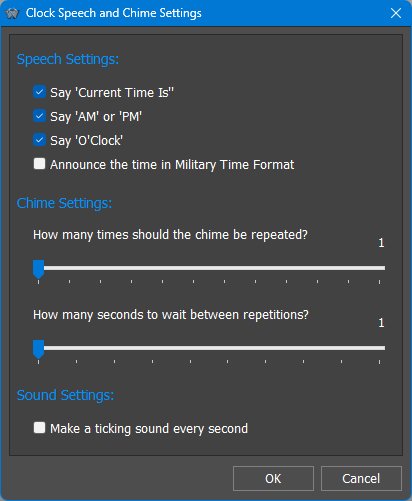
Voice Theme. Selects the voice pack used for spoken module announcements. The Clock module can speak the time in different languages, and the Email Checker module can announce that new mail has arrived and report how many unread messages are waiting.
Test Voice / Open Folder. Tests the currently selected voice or opens the folder containing voice files.
Silent period. The From/To controls define a time range during which Nexus should not play sounds or announcements. This is useful for clock chimes, email notifications, and other audio events that should not occur at night.
Disable all voices. Turns off spoken announcements while leaving normal event sounds available.
Disable all sounds. Makes Nexus silent even if a theme or module would normally play sounds.
5.9 Tasks tab
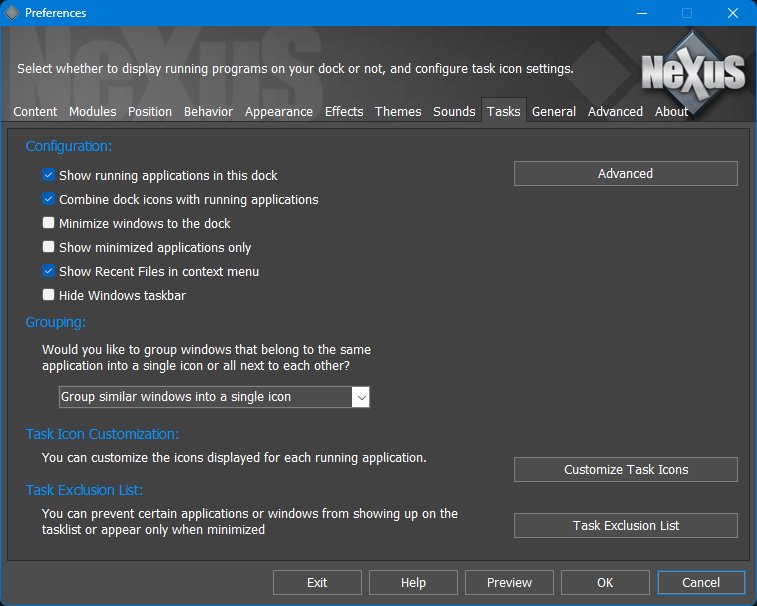
The Tasks tab controls how running applications appear in the Nexus Dock. These settings affect global task management behavior, not the contents of a single Dock item.
Running task context menus offer commands beyond the standard Windows task menu. Depending on configuration, they can include options to set a window's opacity, minimize all similar windows, or restore all similar windows from the same application at once. These commands are useful when an application has many related windows open and you want to manage them as a group.
Preferences - Tasks tab nxtasks.jpg
Combine dock icons with running applications. When a dock already contains a shortcut to an application and that application is running, the dock does not add a second icon for it in the running tasks section of the dock. Instead, the existing dock shortcut also becomes the task icon and shows a running indicator. As in the Windows taskbar, the same icon can then both launch the application and represent its running window. Moving the mouse over it can show live previews, and task-related actions are available from the same dock item.
Minimize windows to the dock. Sends the window minimize animation to the matching icon in the dock instead of to the corresponding button on the Windows taskbar. This makes minimized windows visually appear to collapse into the dock item that represents them.
Show minimized applications only. Restricts task display to minimized windows, instead of showing every running application.
Show Recent Files in context menu. Adds recent-document entries to supported application context menus.
Hide Windows taskbar. Lets Nexus take over task/taskbar duties by hiding the Windows taskbar.
Grouping. Controls whether windows belonging to the same application are grouped into a single task icon or shown separately. Grouping is useful for browsers, Explorer windows, editors, and other applications that often have many windows open at the same time.
Grouped task indicator. When one task icon represents several grouped windows, Nexus can show no additional indicator, display a numeric instance counter,
an instance badge, or draw stacked copies of the icon. Stacked icons show one rear copy when two windows are grouped and two rear copies when more than two windows are grouped.
Customize Task Icons. Opens task icon customization so individual running applications can use preferred icons instead of the icon Windows reports at runtime.
Task Exclusion List. Opens the list of applications or windows that should not appear in Nexus task displays, or should appear only under specific conditions.
Advanced Task Settings
Advanced Tasks settings wstasksadvanced.jpg
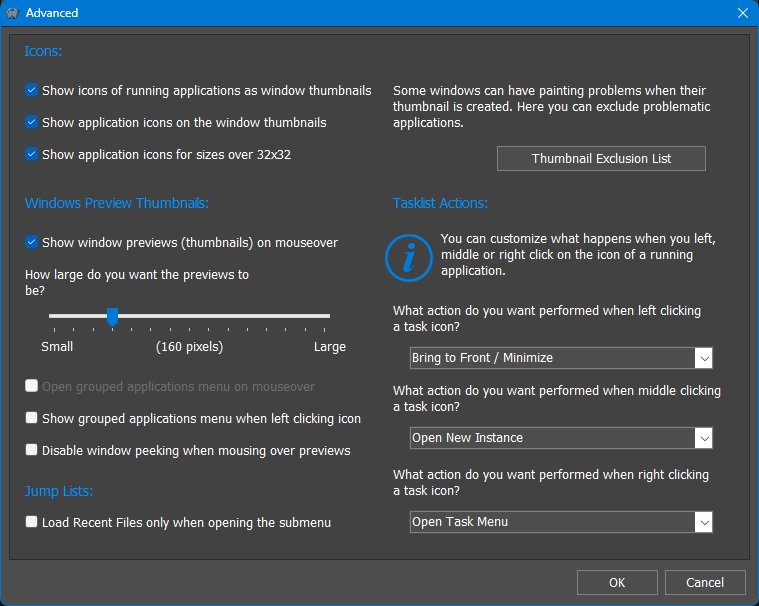
Show icons of running applications as window thumbnails. Displays captured window thumbnails instead of simple application icons when possible. Some applications do not allow their windows to be captured correctly, so those tasks may still show the normal application icon.
Show application icons on the window thumbnails. Overlays the application icon on the task thumbnail, making thumbnails easier to identify.
Show application icons for sizes over 32x32. For task icons up to 32x32 pixels, Nexus can try to use the icon exposed by the actual window, which may be different from the application's main icon. For task icons larger than 32x32, Nexus uses the application's main icon instead, because windows normally do not provide high-resolution window-specific icons.
Thumbnail Exclusion List. Opens the list of applications or windows that should not use captured window thumbnails. This is useful for applications that do not paint correctly when Nexus tries to capture a thumbnail.
Show window previews on mouseover. Shows live window preview thumbnails when the mouse pointer rests over a task icon. This makes it easier to identify a window before switching to it, especially when several similar windows are open.
Preview size. Adjusts how large the live window previews are.
Show grouped applications menu when left clicking icon. Controls what happens when you left-click a grouped task icon. When disabled, left-clicking the grouped icon shows live preview thumbnails for the grouped windows. When enabled, left-clicking opens a menu listing the associated windows instead; moving the mouse over a menu entry shows the live preview for that window.
Disable window peeking when mousing over previews. Prevents Aero Peek-style window peeking when moving over task previews.
Jump Lists / Load Recent Files only when opening the submenu. Loads an application's recent-file list only when the Recent Files submenu is opened, instead of checking it while the main menu is being built. This makes the main menu open faster. The trade-off is that Nexus does not know in advance whether that application actually has recent files, so the Recent Files option may still appear even when the submenu is empty.
Tasklist Actions. Defines what happens when you left-click, middle-click, or right-click a running application icon. Typical actions include bringing the window to the front, minimizing it, restoring it, closing it, or opening the task menu.
Force tasklist polling. Refreshes the list of running applications once per second instead of relying only on Windows shell notifications. Enable this only when task icons take several seconds to appear or disappear because shell notifications are delayed or unreliable. Polling provides a compatibility fallback but can increase CPU usage.
Drag-over task activation. Dragging over a running task icon, or over a live preview thumbnail when tasks are grouped, can bring that window forward after a short delay. This lets you drag files to a running application even when its window is currently hidden behind other windows: drag the file over the task, wait for the window to come forward, and then drop the file into the application.
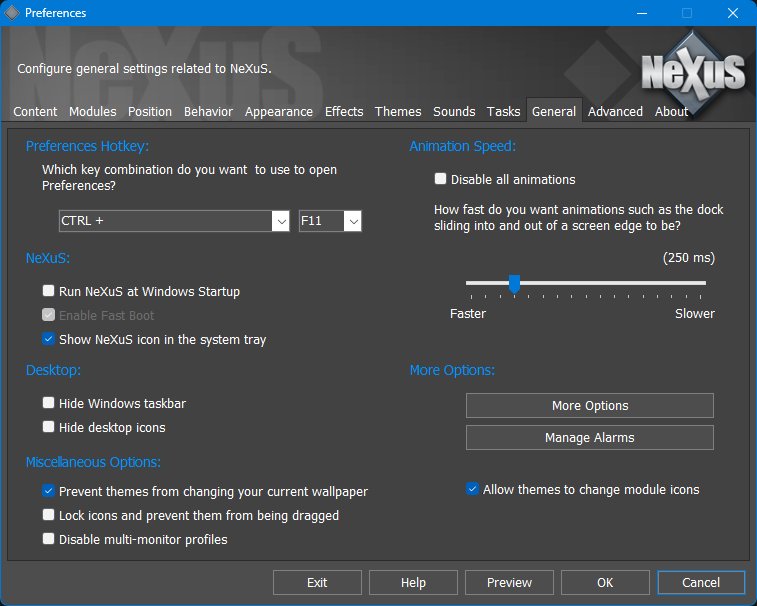
5.10 General tab
Preferences - General tab nxgeneral.jpg
The General tab contains common application-wide behavior: the Preferences hotkey, startup behavior, animation speed, desktop/taskbar integration, miscellaneous protection options, alarms, and theme-related shortcuts.
Preferences Hotkey. Defines the key combination used to open Nexus Preferences from the keyboard. The default shown is CTRL+F11.
Animation Speed. Controls the speed of Nexus animations, such as the Dock sliding into or out of a screen edge. Faster values make animations complete more quickly; slower values make them more gradual.
Run Nexus at Windows Startup. Starts Nexus automatically when Windows starts.
Enable Fast Boot. Uses a faster startup path so Nexus becomes available sooner after Windows starts.
Show Nexus icon in the system tray. Displays the Nexus notification area icon, which provides another way to access Preferences and common commands.
Hide Windows taskbar. Hides the standard Windows taskbar when Nexus is being used as the primary desktop interface.
Hide desktop icons. Hides icons on the Windows desktop.
Prevent themes from changing your current wallpaper. Keeps the current wallpaper when applying themes that include wallpapers.
Lock icons and prevent them from being dragged. Globally prevents item icons from being accidentally moved by dragging.
Disable multi-monitor profiles. Disables Nexus's monitor-profile behavior for systems where display layout changes should not produce separate profiles.
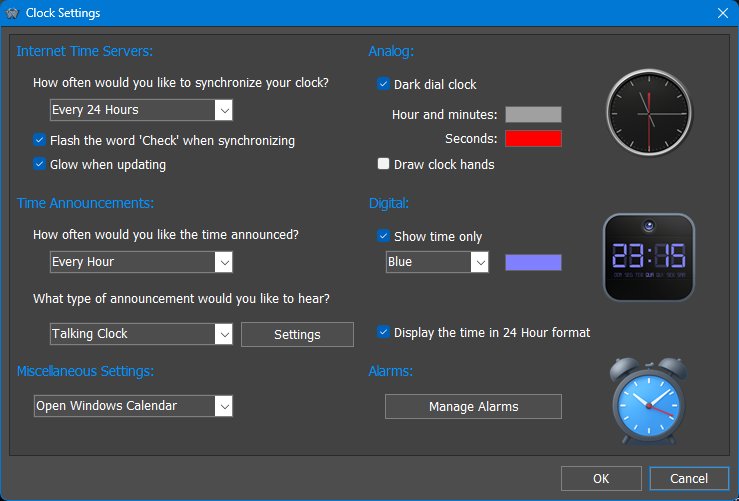
Allow themes to change module icons. Allows themes to replace the artwork used by modules when the theme provides its own module images. For example, a theme that includes an analog Clock face bitmap can override the default Clock face. Disable this option if you want iconic modules to keep their current/default images when changing themes.
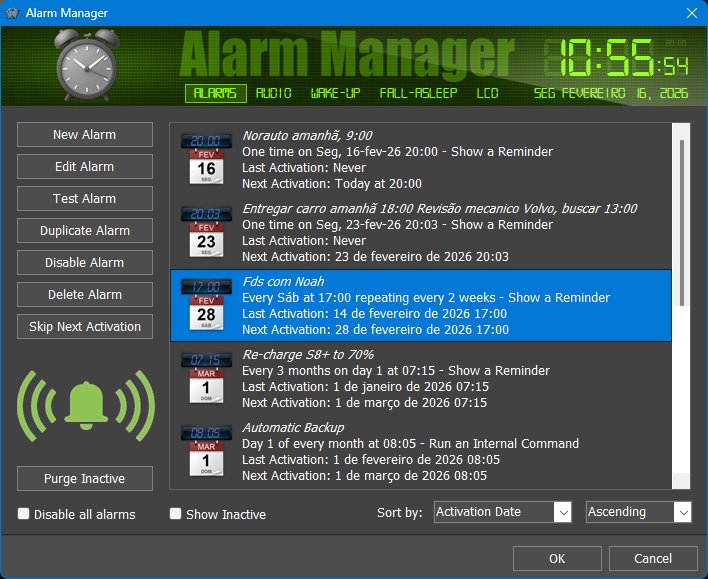
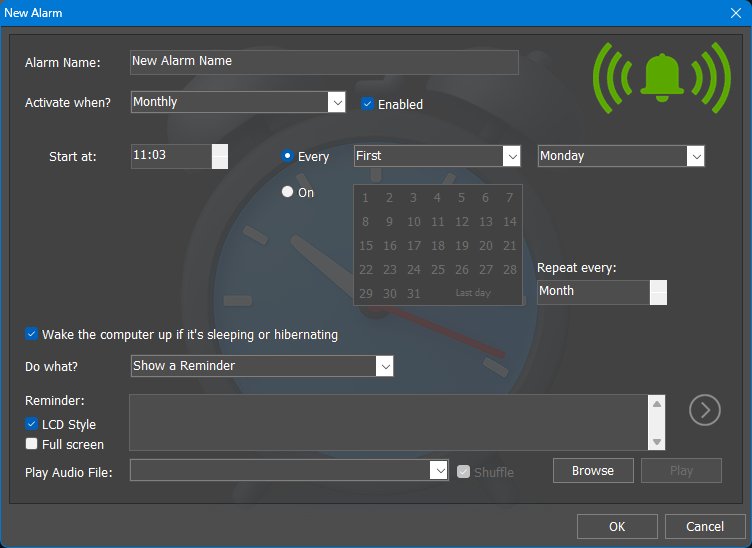
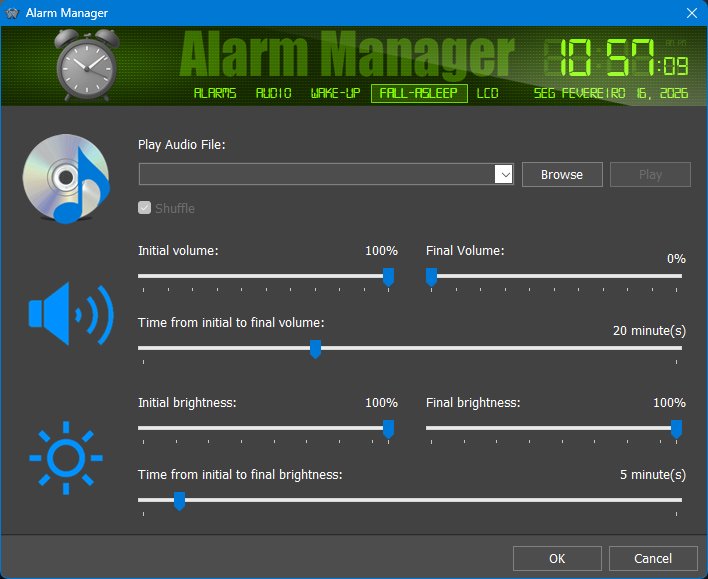
Manage Alarms. Opens the Alarm Manager, where the user can create and manage reminders, wake-up alarms, sleep timers, and related alarm actions.
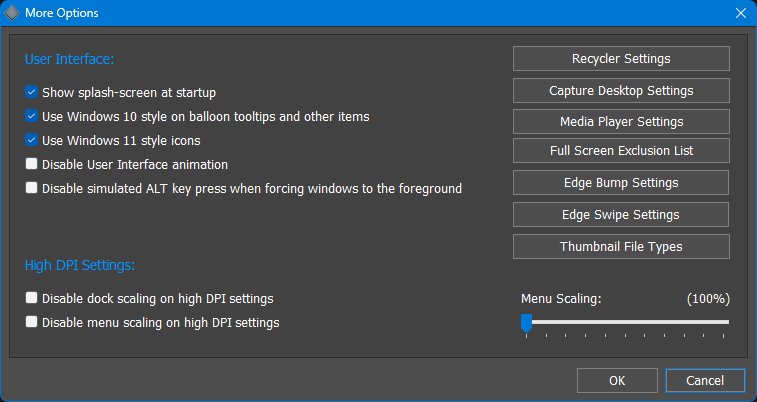
More Options
General More Options dialog wsgeneralmoreoptions.jpg
Show splash-screen at startup. Controls whether the Nexus splash screen appears while the application starts.
Use Windows 10 style on balloon tooltips and other items. Uses a more modern Windows 10-style presentation for balloon tooltips and related UI elements.
Use Windows 11 style icons. Uses Windows 11 style icons where available.
Disable User Interface animation. Disables slide/fade animations used by the Preferences interface and related UI panels.
Disable simulated ALT key press when forcing windows to the foreground. Windows normally prevents applications from arbitrarily stealing keyboard focus. Nexus can use a simulated ALT key press as a compatibility workaround when it needs to bring a window to the foreground, because Windows treats that as recent user input. Enable this setting if the workaround causes unwanted side effects on your system or with a specific application.
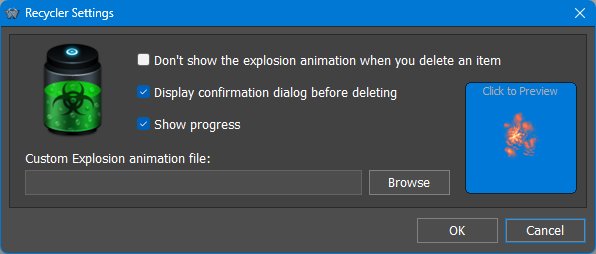
Recycler Settings. Opens the Recycler settings dialog. These options control how the Recycler module behaves, including confirmation, deletion, emptying, and related Recycle Bin behavior used by Nexus.
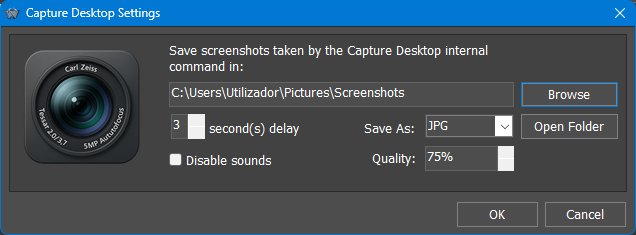
Capture Desktop Settings. Opens the settings for the Capture Desktop internal command. These options control how desktop screenshots are captured, saved, and handled when the command is used.
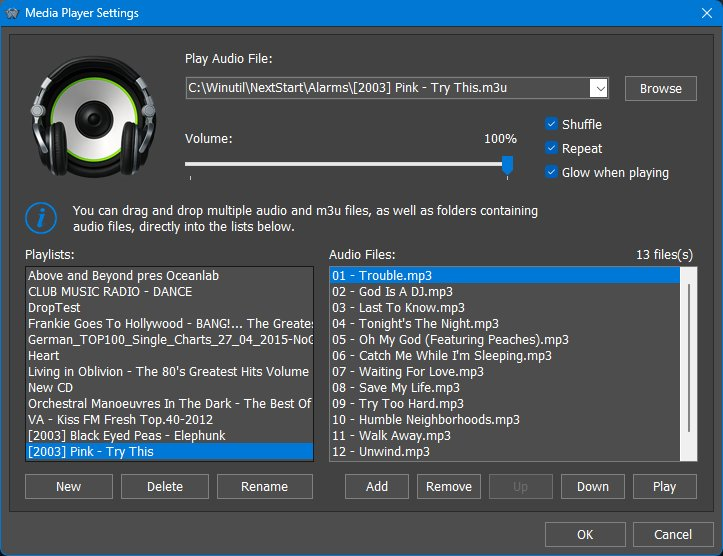
Media Player Settings. Opens the settings used by the Media Player internal command and related media-control commands. These options control how Nexus interacts with the selected media player.
Full Screen Exclusion List. Opens the list of applications that should be excluded from Nexus's full-screen detection behavior. This is useful for applications that use unusual borderless or full-screen windows but should not disable edge activation or pause module updates.
Edge Bump Settings. Opens the global settings for screen-edge bump activation. Edge bumps are used to activate hidden or collapsed objects when the mouse pointer is pushed against a screen edge.
Edge Swipe Settings. Opens the global settings for screen-edge swipe activation. Edge swipes provide an alternative activation gesture for the Dock and other screen-edge objects in commercial Winstep products.
Thumbnail File Types. Opens the list of file extensions that Nexus treats as thumbnail-capable document or image types. This controls which file types can show document thumbnails instead of ordinary file icons when displayed in the Dock, folder menus, menus, or other supported views.
Disable dock/menu scaling on high DPI settings. These check boxes disable automatic high-DPI scaling for the corresponding object types when the user wants their original unscaled size.
Menu Scaling. Sets the manual scaling percentage used by Nexus menus. This is useful on high-DPI displays or for users who need larger menu text and icons for easier reading. Since menus do not have their own Preferences tab, their scaling is adjusted here.
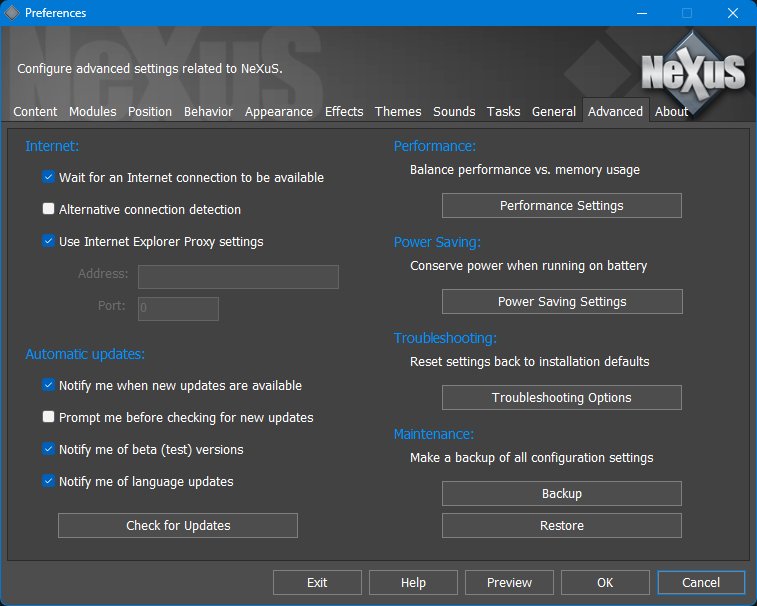
5.11 Advanced tab
Preferences - Advanced tab nxadvanced.jpg
The Advanced tab contains application-wide technical settings for internet access, updates, performance, power saving, troubleshooting, backups, and maintenance.
Internet settings. Controls how Nexus detects an internet connection and whether it uses Internet Explorer proxy settings. These options affect internet-aware features such as weather, email checking, update checks, online content, and other network-dependent modules.
Wait for an Internet connection to be available. Delays internet operations until a connection is available, useful on systems that are not always online.
Alternative connection detection. Uses an alternate method to detect whether the system is online, useful when the normal detection method gives incorrect results.
Use Internet Explorer Proxy settings. Uses the proxy configuration stored in Internet Explorer/Windows internet settings.
Notify me when new updates are available. Allows Nexus to automatically check for new application updates and notify you when one is available.
Prompt me before checking for new updates. Makes Nexus ask for confirmation before performing an automatic update check, instead of checking silently in the background. When this option is enabled, automatic checks are performed once a week; when it is disabled, automatic checks are performed once per day.
Notify me of beta (test) versions. Includes beta/test releases in update notifications. Leave this disabled if you only want to be notified about final public releases.
Notify me of language updates. Checks for updated language files and notifies you when newer translations are available.
Check for Updates. Manually checks for available Nexus/Winstep updates immediately.
Backup and Restore. The Backup and Restore commands protect the current Nexus configuration. Periodic automatic backups can also be scheduled through the Alarm Manager by creating an alarm that runs the Auto-Backup Settings internal command.
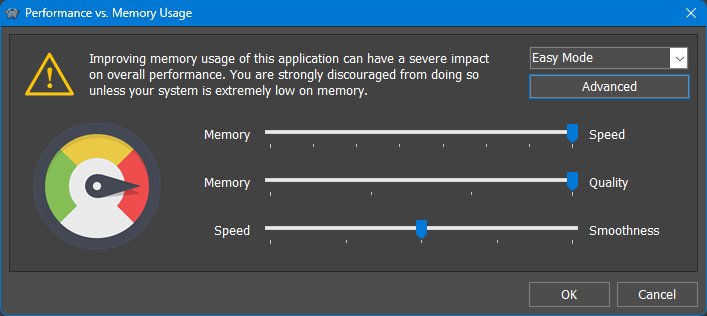
Performance Settings
Performance settings wsperformance.jpg
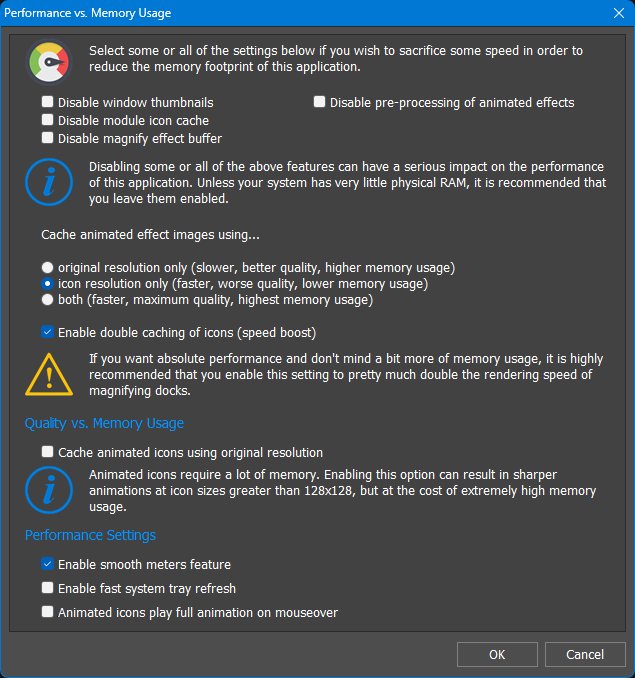
The Performance Settings dialog balances memory usage, speed, visual quality, and animation smoothness. The warning at the top is intentional: reducing memory usage can have a severe impact on overall performance and should normally be done only on systems with very little available memory.
Easy Mode. Provides a simplified way to adjust the main performance trade-offs without manually choosing every cache, animation, and rendering option.
Memory vs. Speed. Moving toward Memory reduces memory usage by using fewer caches and preprocessed graphics. Moving toward Speed uses more memory to make drawing, thumbnails, animations, and icon rendering faster.
Memory vs. Quality. Moving toward Memory favors lower memory usage. Moving toward Quality preserves more detail or higher-resolution cached graphics where applicable, at the cost of using more memory.
Speed vs. Smoothness. Moving toward Speed favors faster response and lower overhead. Moving toward Smoothness favors smoother animation and transitions, which may require more processing.
Advanced. Opens the Advanced Performance dialog for manual control over caches, animated effect images, smooth meters, smooth text, tray refresh, and animated icon behavior.
Disable window thumbnails. Reduces memory use by disabling cached or generated window thumbnails, at the cost of thumbnail-related features.
Disable module icon cache. Saves memory by reducing cached module icon images, but may slow module icon rendering.
Disable magnify effect buffer. Saves memory used by magnification rendering buffers, but can affect smooth dock magnification performance.
Disable pre-processing of animated effects. Saves memory by avoiding preprocessed animation frames, but animated effects may take more CPU or appear less responsive.
Cache animated effect images using original resolution / icon resolution / both. Controls whether animated effect images are cached at original resolution, icon resolution, or both. Original resolution favors quality at higher memory cost; icon resolution favors speed and lower memory use; both favors speed and maximum quality at the highest memory cost.
Enable double caching of icons. Uses more memory to substantially speed up icon rendering, especially for Dock magnification.
Cache animated icons using original resolution. Makes animated icons sharper at larger icon sizes, but can use a large amount of memory.
Enable smooth meters feature. Smooths gauge needles, bars, and similar meter indicators. Instead of jumping to the new value every time the module updates, the indicator moves smoothly into position.
Enable fast system tray refresh. Refreshes tray icons more often to support smoother animated tray icons, at the cost of additional overhead. This setting affects tray processing only and does not control how quickly running application task icons appear or disappear.
Network and volume tray icons. The network tray icon can show Wi-Fi signal strength when Windows location privacy settings permit access to that information. Audio-device changes for the volume tray icon are detected through Windows device-change notifications, avoiding unnecessary continuous device enumeration.
Animated icons play full animation on mouseover. Lets animated icons complete their full animation when triggered by mouseover.
Power Saving Settings
Power Saving settings wspowersaving.jpg
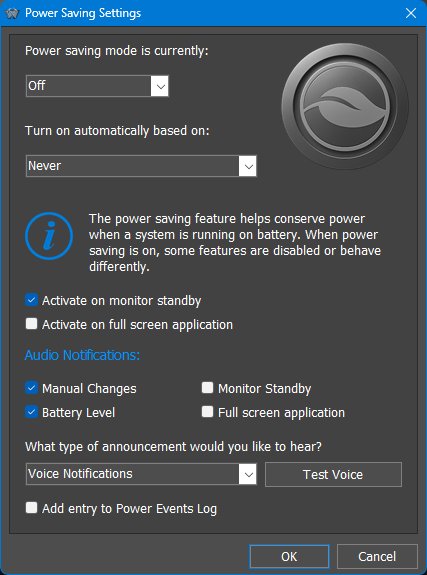
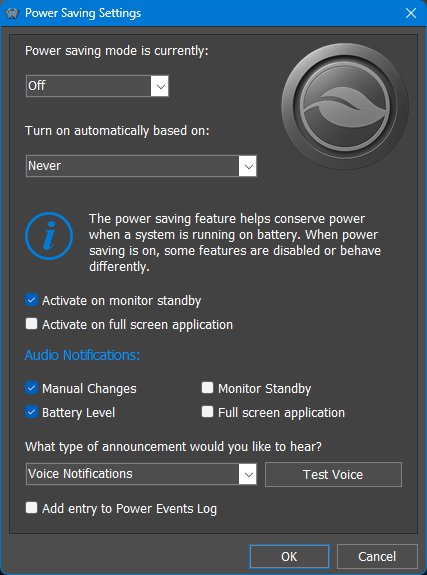
The Power Saving Settings dialog is especially important on laptops and tablets. Nexus can reduce CPU usage and power consumption by lowering polling/update rates and disabling non-essential animations or cosmetic effects.
Current power saving mode. Shows whether power saving is currently off or running in Normal or Ultra mode.
Normal power saving. Reduces module update rates, stops or slows non-essential animations, and reduces background polling while preserving the most important interactive effects.
Ultra power saving. Applies the Normal mode savings and goes further by updating modules less often and disabling more animated effects, including more mouseover and launch effects.
Normal and Ultra details. The exact changes made by Normal and Ultra power saving modes are listed in the Power Saving Mode internal command section. This dialog controls when those modes are enabled automatically; the internal command can also be used to toggle the same modes manually.
Turn on automatically based on. Selects the condition or combination of conditions that automatically enable power saving, such as specific battery levels, Windows Battery Saver, monitor standby, or a full-screen application.
Activate on monitor standby. Enables power saving when the monitor enters standby.
Activate on full screen application. Enables power saving while a full-screen application is running, useful for games, video playback, and presentations.
Power change audio announcements. Controls whether Nexus announces power saving mode changes, and whether those announcements use voice or sound notifications. Announcements can be triggered by manual changes, battery-level events, monitor standby, or full-screen application detection.
Test Voice. Plays a sample using the currently selected voice so you can confirm how spoken power change announcements will sound.
Add entry to Power Events Log. Records power saving mode changes in the Power Events Log. In the free version of Nexus this is mainly useful for diagnosing automatic power saving changes triggered by battery power, Windows Battery Saver, monitor standby, or full-screen applications.
Troubleshooting Options
Troubleshooting options wstroubleshooting.jpg
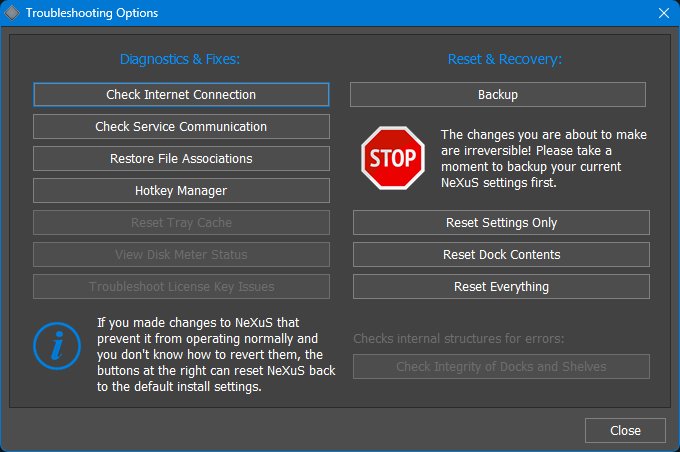
The Troubleshooting Options dialog contains diagnostic, repair, reset, backup, recovery, and compatibility tools. The buttons on the left are intended to diagnose or fix specific problems. The buttons on the right can reset parts of the Nexus configuration and should be used with more care.
Check Internet Connection. Tests whether Nexus can reach the Internet using the current Internet settings. This is useful when online features such as weather, email checking, update checks, online theme access, or other network-dependent features are not working as expected.
Check Service Communication. Tests communication with the Winstep Service. The service is a small helper component used for operations that require elevated or system-level access while allowing Nexus itself to keep running normally under the user's account. This avoids the security risk of running the whole application elevated just to perform a few privileged operations. Service communication is especially important for features that need low-level system or hardware information.
Restore File Associations. Restores file associations used by Nexus/Winstep, such as associations for Winstep theme packages or other supported Winstep file types. Use this if double-clicking a Winstep-related file no longer opens or imports it correctly.
Hotkey Manager. Opens a central list of currently assigned hotkeys. Hotkeys can activate the Dock and can also be assigned to individual items so an application, document, folder, or internal command can be launched directly from the keyboard. Because item hotkeys are not always visible while browsing the Dock, the Hotkey Manager lets you view, change, or delete all assigned hotkeys from one place.
Test Exception Handler. Deliberately triggers a test exception to verify that the Winstep Exception Handler is working correctly. Warning: If the exception handler itself fails, the application may be unable to recover and could terminate unexpectedly.
Fix Windows 11 CPU Usage Reporting. Opens the Windows 11 CPU usage reporting fix dialog. This setting is intended to fix the apparent 4x higher CPU usage that may sometimes be reported for Nexus while idle, usually after returning from a low-power state. Extensive profiling has shown that Nexus is not actually using 4x more CPU - the increase is caused by Windows 11 incorrectly accounting for and reporting the application's CPU usage. This issue is specific to Windows 11 and does not occur under Windows 10 or earlier versions of Windows.
This option controls the Windows Serialize Timer Expiration kernel setting, which determines how Windows coordinates the processing of timer expirations across multiple processors. A bug introduced in Windows 11 22H2 caused this timer and clock-processing mechanism to produce incorrect - and often substantially inflated - per-process CPU usage values. The problem affected third-party applications system-wide and even caused Windows' own Task Manager to display incorrect CPU usage figures. Setting Serialize Timer Expiration to Off was found to work around the problem, and Winstep exposed this setting in earlier versions. Microsoft later appeared to correct the underlying issue in subsequent Windows 11 releases, so the workaround was eventually hidden.
More recent testing has shown that the same type of incorrect CPU accounting can apparently still return under certain conditions, particularly following sleep/resume cycles. Another sleep/resume cycle may cause CPU reporting to return to normal again.
The setting should normally be left at Auto. On systems that do not support Modern Standby, setting it to Off may work around incorrect CPU usage reporting. Because this changes system-wide Windows kernel timer behaviour and may have unintended effects on power management or other system behaviour, the setting is disabled on systems that support Modern Standby. Changes to this setting require a reboot to take effect.
Diagnostics and fixes are safer than resets. If you made changes that prevent Nexus from operating normally and you do not know how to undo them, the buttons in the left column are the first place to look. They are designed to check or repair specific problem areas without resetting the whole configuration.
Backup. Creates a backup of the current Nexus configuration. This button is placed above the reset commands because the changes below it are immediate and irreversible. Create a backup before using reset or recovery commands unless you are sure you do not need to preserve the current configuration.
Reset Settings Only. Resets Nexus settings while leaving the Dock and its contents intact. Use this when the problem appears to be caused by application settings rather than by the object structure itself.
Reset Dock. Resets the Nexus Dock configuration. This affects the Dock layout and Dock item structure managed by Nexus. Use this only when the Dock layout is damaged or needs to be rebuilt.
Reset Everything. Resets the full Nexus configuration back to its default installation state. This is the most drastic reset option and should only be used when other recovery options are not enough.
5.12 About tab
The About tab is the first page shown when the main Preferences window opens. It provides version, build, registration, support, update-related information, language selection, and general user-interface style options.
Preferences - About tab nxabout.jpg
Language. Selects the language used by the Nexus user interface. On first run, Nexus automatically selects the most appropriate language based on the system code page, but you can override that choice here.
User Interface. Selects the visual style used by Nexus configuration dialogs. Available choices include Standard User Interface, Dark Mode (Black), Dark Mode (Gray), Dark Mode (Midnight), Light Mode, and Winstep.
On Windows 10 and later, Nexus checks the current Windows light/dark mode on first run. If Windows is using Light Mode, Nexus automatically selects Light Mode. If Windows is using Dark Mode, Nexus selects Dark Mode (Black) under Windows 10 and Dark Mode (Gray) under Windows 11. Standard User Interface is selected automatically on versions of Windows prior to Windows 10, and can also be selected manually when you want the dialogs to remain compatible with third-party skinning utilities such as WindowBlinds. Winstep mode is a cosmetic mode that uses a black-and-gray style inspired by the Winstep web site.
Colorize User Interface. The Red, Green, and Blue sliders adjust the color tint used by parts of the Preferences interface, including the top Preferences banner. In non-dark user interface modes, the sliders also affect section titles inside the Preferences tabs. In dark modes, section titles use the current Windows accent color instead.
Version and updates. The version number identifies the installed Nexus version. Use Check for Updates to manually check for newer versions through the Winstep Update Manager. By default, the Update Manager also checks silently for updates once per day and only notifies you when new updates are found. The Update Manager presents update information and download progress in a clearer layout, including percentage complete and estimated time remaining while downloading.
Open Data Folder. Opens the folder where Nexus stores user data, settings, themes, backups, and related configuration files.
Support and web site links. The support email and web site links provide quick access to Winstep support and online resources.
6. Working with the Dock
Practical Dock organization. The Nexus Dock is best for frequently used launchers, running tasks, quick-access tools, modules, folders, documents, URLs, and Internal Commands.
The Dock is an icon strip for launching applications, opening documents and folders, displaying running tasks, hosting modules, and organizing frequently used items. In Nexus Free there is one Dock, configured from the main Preferences dialog.
Example Dock nxdock.jpg
The Dock can be attached to a screen edge or left floating. When docked, it can be aligned along the selected edge, optionally span the full screen width or height, reserve or respect screen space, auto-hide into the edge, and be activated by bumping or swiping the screen edge. A floating Dock can be placed freely on the desktop and can collapse when not in use.
The Dock can contain many kinds of items: applications, folders, documents, URLs, modules, Internal Commands, separators, and running task representations. This makes it useful both as a launcher and as a task-management area.
Each Dock includes an optional Dock control icon/tile. The control icon gives access to the Dock context menu and is used for operations such as opening Preferences, changing Dock-related settings, accessing appearance and sound options, locking icons, showing desktop icons, and opening other Nexus commands. Depending on the Dock settings, the control icon may be visible or hidden.
The Dock control icon can also be used directly in drag-and-drop operations. Depending on context and settings, dragging the control icon can help move the Dock or perform Dock-related actions. This is another reason the control icon is important even when most day-to-day launching happens through ordinary Dock items.
Opening Preferences. Open Preferences from the Dock control icon/context menu, from the Nexus submenu available in Dock item context menus, or by using the Nexus system tray/menu entry where available.
Dock contents. Dock items may be applications, folders, documents, URLs, modules, Internal Commands, separators, or task representations. Items can be added, removed, renamed, rearranged, customized, or configured through drag-and-drop and right-click context menus.
Drag and drop. Items can be dragged into the Dock from Explorer, the Start menu, the desktop, and compatible Windows locations. Dragging files, folders, shortcuts, URLs, or images to the Dock can create new Dock items, open documents with applications, or customize item images depending on where and how the item is dropped.
6.1 Dock context menus and shell integration
Dock right-click menus combine Nexus object management with the normal Windows shell context menu where appropriate. This is why an application shortcut can show Nexus commands such as Dock Entry Properties, Rename, Remove from Dock and Insert New Dock Item, followed by the same file/application commands and third-party shell extensions you would see in Explorer.
A normal application shortcut in a Dock combines Winstep commands with the Windows shell context menu for the target application.
The Dock control icon is the main command surface for the Dock itself. The same Dock-level menu is also available from the NeXuS submenu in the right-click menu of individual Dock items.
The Dock control icon context menu exposes Preferences, appearance, effects, auto-hide, locking, module and exit commands.
Folder shortcuts and other special Dock items expose their own relevant commands directly in the context menu, such as opening item Properties or changing how a folder is browsed.
6.2 Moving and docking the Dock manually
When movement is allowed, click an empty space between Dock icons and drag to align or move the Dock. Holding Alt while left-clicking
anywhere in the Dock also allows the Dock to be dragged horizontally.
Drag a docked Dock away from the screen edge to undock it, you should feel a
some resistance, that is normal. When the mouse pointer approaches a screen edge, the Dock automatically docks to that edge.
6.3 Dock styles
The Dock can use native Nexus/Winstep themes, dock backgrounds, tile-based styles, and themes made for compatible third-party docks such as RocketDock, ObjectDock, and Y'z Dock. This gives Nexus access to many third-party dock themes available online, in addition to native Winstep themes.
Native Winstep themes provide the richest skinning support because they can define more than just the dock background. Third-party dock skins are useful for quickly applying simpler dock visual styles, but they usually affect only the dock background, tiles, or related dock artwork.
The Themes tab and related style, colorization, and blur settings control the visual style for a specific Dock.
Dock using a themed background nxdockgrass.jpg
6.4 The Dock as a workflow entry point
A dock is often the fastest way to begin a task. Keep the main dock focused on the applications, documents, folders, modules, and internal commands used every day, then move less frequent items into groups or folder menus. This keeps the dock compact without hiding functionality.
6.5 Opening documents through dock applications
Dock items are not limited to being clicked. Dropping a document onto an application icon opens that document with that application, just as in Windows. This is useful for tools such as editors, image programs, archive managers, media players, and development utilities.
6.6 Changing item images by drag & drop
To personalize a dock or make a workflow more visually obvious, drag a supported icon or image file onto an existing item to change that item's image. This works especially well when a project uses custom icons or when imported shortcuts have poor default artwork.
6.7 The Dock as a task manager
The Nexus Dock can be used as a launcher, task manager, or both. It can show pinned items and running applications together, only running tasks, only minimized windows, or a filtered subset of tasks.
When task grouping is enabled, multiple windows from the same application can be represented by a single grouped icon. Hovering or clicking can then reveal live previews or a task list, depending on the selected task behavior.
6.8 Document routing through Dock items
Dock items can accept files dropped onto them. This is a practical everyday shortcut: drop a document onto Word, a text file onto Notepad, an image onto an image editor, or a folder onto a utility that accepts folders. Supported UWP application items also participate in this behavior, which helps modern Windows apps behave consistently with classic desktop applications.
7. Modules
Modules are built-in Nexus mini-applications that appear as compact items inside the Dock. They are practical instruments, not just decorations: depending on the module, they can monitor system activity, network activity, mail status, weather, time, recycle bin status, or other useful information.
The modules documented for the free version of Nexus are Clock, Recycler, CPU Meter, RAM Meter, Net Meter, Email Checker, Weather Monitor, and Wanda. Additional modules are available in commercial Winstep products and are not covered in this guide.
7.1 Module context menus
Modules expose many of their options through right-click context menus. A module context menu can open the module settings, switch styles, change themes, disable module-specific sounds or animations, or provide actions related to the information shown by the module.
A module context menu can combine module-specific commands, Dock item commands, insertion submenus, theme/style commands and parent Dock commands.
7.2 Iconic modules
In the free version of Nexus, modules are used in iconic form on the Dock. Iconic modules behave like live Dock items: they can show status, open module-specific menus, and provide quick access to their settings.
Desktop widget versions of modules and additional modules are available in commercial Winstep products, but they are outside the scope of the free Nexus guide.
7.3 Clock module
The Clock module shows the current time as either an analog or digital clock. It can synchronize the system clock with Internet time servers, announce the time using installed voice files, and provide access to alarms.
The Clock module has two digital-style variants: one displays both a calendar and the time, while the other displays only the time. This lets the user choose between a more informative compact clock or a simpler time-only presentation.
Clock module settings wsclocksettings.jpg
How often would you like to synchronize your clock? Selects how often Nexus synchronizes the computer clock with Internet time servers. This keeps the system clock accurate without requiring the user to adjust it manually.
Flash the word 'Check' when synchronizing. Flashes the word "Check" while the Clock module is checking or synchronizing the time.
Glow when updating. Makes the Clock module glow while the time is being updated.
How often would you like the time announced? Selects how often the Clock module announces the current time.
What type of announcement would you like to hear? Selects the announcement type used for spoken time announcements. Click Settings to configure the selected announcement style.
Miscellaneous Settings. Selects what happens when the Clock module is clicked. For example, the Clock can open the Windows.
Dark dial clock. Uses the dark analog clock face, unless the current theme or a user-defined clock face overrides it. The analog clock face can also be customized with the Change Icon button in Preferences > Modules. A user-defined clock face overrides the theme-provided clock face.
Hour and minutes. Sets the color used for the analog clock's hour and minute hands, unless overridden by the current theme or by a custom clock face/icon.
Seconds. Sets the color used for the analog clock's seconds hand, unless overridden by the current theme or by a custom clock face/icon.
Draw clock hands. Forces the iconic analog Clock module to draw thicker clock hands instead of using bitmap clock hands supplied by the current style or theme. This can make the clock easier to read when theme-provided bitmap hands are too thin or do not contrast well with the clock face.
Show time only. Uses the digital Clock style that shows only the time, instead of the digital style that also includes a small calendar/date area.
Digital clock color. Sets the color used for the digital Clock text, unless the current theme overrides it.
Display the time in 24 Hour format. Displays the digital time using 24-hour format instead of AM/PM format.
Manage Alarms. Opens the Alarm Manager, where alarms and scheduled reminders can be created and managed.
Speech Settings. Controls the words included in spoken time announcements, such as whether to say "Current Time Is," "AM/PM," "O'Clock," or use military time format.
Clock speech and sound settings wsclocksettingssound.jpg
Chime Settings. Controls how clock chimes repeat and how long to wait between repetitions.
Sound Settings. Enables optional clock sounds such as a ticking sound every second.
What the Clock is useful for
The Clock module is more than a visible clock. It can synchronize the system time with Internet time servers, announce the time using installed voice packs, obey a silent period so spoken announcements do not occur at night, and act as the entry point to the Alarm Manager.
Multiple Clock items can be configured with different time zones, making them useful for remote teams, family abroad, servers in another region, or customers in different countries. Daylight saving time is handled by the selected time zone rather than by manual offsets.
To show multiple time zones, add more than one Clock module item and configure each one separately. Right-click a Clock item, open its properties or settings, and use the time zone option to select the city or time zone that clock should display.
7.4 Recycler module
Recycler module settings wsrecyclersettings.jpg
The Recycler module reflects the status of the Windows Recycle Bin and allows files, shortcuts, and compatible Nexus items to be deleted by dropping them onto the module.
Delete animation. Controls whether the module plays its explosion animation when an item is deleted.
Confirmation and progress. Controls whether Nexus displays a confirmation dialog before deleting and whether delete progress is shown.
Custom explosion animation. Allows a custom animation file to be selected for the delete effect.
7.5 CPU Meter module
CPU Meter settings wscpusettings.jpg
The CPU Meter module monitors processor activity. Depending on the selected module style, it can appear as a gauge, histogram, or other theme-provided CPU display. Clicking the module opens the Windows Task Manager, and hovering the mouse pointer over the module can show which application is currently using the most CPU.
Graphic Settings. Configures how the selected iconic CPU Meter style is drawn, including the graph or meter colors used by that style.
Show CPU Meter icon in the system tray. Adds a CPU Meter icon to the Windows notification area, allowing CPU activity to be monitored even outside the Nexus module itself.
Most Active Programs. Opens a panel showing which programs have been using the most CPU recently.
CPU Meter Most Active Programs panel wscpumostactive.jpg
The Most Active Programs panel lists the two applications that have been using the most processor time over the last few minutes. This makes it easier to identify programs or background services that are consuming CPU resources.
CPU usage, cores and hyper-threading
CPU usage is calculated against the total processing capacity of the system, not against a single processor core. On a multi-core system, 100% CPU usage means that all available cores are fully busy. If hyper-threading is enabled, Windows treats the additional logical processors as part of that total capacity.
This means that a single-threaded program can be maxing out one core while still showing only a fraction of total CPU usage. For example, on a system with four physical cores and hyper-threading enabled, Windows sees eight logical processors. A process using one logical processor completely would therefore appear as roughly 12.5% of total CPU usage.
Multi-threaded programs can use more than one core at the same time, so they can show higher CPU percentages. This is why the same percentage can mean different things on different computers: it depends on how many physical and logical processors the system has.
What the CPU Meter is useful for
The CPU Meter is useful for keeping an eye on overall processor activity and for quickly spotting programs that are consuming too much CPU. It can provide a compact always-visible activity meter inside a Dock or menu, a larger desktop monitor in widget form, and quick access to both Task Manager and the Most Active Programs panel.
Interpreting CPU usage
The CPU Meter is useful for detecting CPU-heavy applications at a glance. On multi-core and Hyper-Threaded systems, a single process using one core at full speed may only appear as a fraction of total CPU because total usage is divided across all logical cores. For example, on an 8-logical-core system, a process saturating one logical core appears around 12.5% CPU.
The desktop version can show top CPU users, and the Most Active Programs view helps identify applications that have been consuming CPU over time rather than only at the current instant.
Understanding CPU percentages on modern processors
CPU usage numbers are normalized across all logical processors. On a CPU with multiple cores and Hyper-Threading, a single-threaded program that fully occupies one logical core may show only a fraction of total CPU usage, because 100% means all cores/logical processors are fully busy. The "Most Active Programs" view is useful because it tells you which applications have been consuming the most CPU over a recent period, not just at the instant you look.
7.6 RAM Meter module
RAM Meter settings wsramsettings.jpg
The RAM Meter shows current memory usage and related memory statistics.
System tray option. The RAM Meter can optionally show an icon in the Windows notification area.
Graphic Settings. Selects how the memory graph is drawn, such as outlined or filled histogram styles, and controls the graphic color where supported.
7.7 Net Meter module
Net Meter settings wsnetsettings.jpg
The Net Meter module monitors bandwidth usage through a selected network adapter. It shows incoming and outgoing traffic and is normally used to monitor Internet activity, but it can also be used to watch any available network interface.
Network Interface Card Settings. Selects which network adapter to monitor. This area also shows information about the selected adapter, including connection type, maximum connection speed, current IP address, and the total number of bytes received and sent through that interface.
Only list physical Network Adapters. Limits the adapter list to physical network interfaces, hiding virtual or software-created adapters where possible.
Maximum Inbound Speed / Maximum Outbound Speed. Optionally sets fixed maximum values for the incoming and outgoing traffic graphs. Leave these values unset to let the Net Meter scale the graph dynamically according to current upload and download activity.
Show Net Meter icon in the system tray. Adds a Net Meter icon to the Windows notification area, allowing network activity to be monitored even outside the Nexus module itself.
Graphic Settings. Configures how the selected iconic Net Meter style is drawn, including options such as graph type and graph color when supported by the current style or theme.
Network Statistics. Opens the Network Statistics panel for the selected interface.
Active Connections. Opens the Active Network Connections panel, which shows current TCP and UDP connections, the processes using them, and the current inbound and outbound bandwidth used by each connection.
Network Statistics panel wsnetstatistics.jpg
The Network Statistics panel displays protocol statistics for the network interface currently being monitored, including TCP, IP, UDP, ICMP In and ICMP Out information.
Active Network Connections panel wsnetconnections.jpg
The Active Network Connections panel displays current TCP and UDP connections, together with information about each connection, the process that owns it, and per-connection inbound and outbound bandwidth usage. It can be accessed from the Net Meter context menu, and can also be opened by double-clicking the Net Meter module.
Text size. Selects Small, Medium, or Large text for the Active Connections list, making the panel easier to read on high-resolution displays or from a greater viewing distance.
The connection list can be sorted in ascending or descending order by clicking the column headers. Columns can be resized by dragging the vertical edges of the column headers, and multiple connections can be selected with the SHIFT or CTRL keys.
New connections appear in green and terminated connections appear in red, making changes easier to follow while the panel is open. Right-clicking a connection opens a context menu with commands to show information about the process, close the connection, terminate the owning process, perform a WHOIS lookup on the remote host, or copy connection information to the clipboard.
The Active Connections panel is resizable, remembers its last size, and can be minimized or left running on the desktop without interfering with other Winstep items.
What the Net Meter is useful for
The Net Meter is useful both as a bandwidth gauge and as a network diagnostic tool. It can show how much data is moving through a selected adapter, provide TCP/IP statistics, and help identify which applications are currently using the Internet or local network. This can be useful when diagnosing unexpected traffic, checking whether a program is communicating over the network, or investigating suspicious background activity.
Use connection commands carefully. Closing connections or terminating processes from the Active Connections panel can interrupt downloads, browsers, cloud sync tools, VPNs, remote sessions or other legitimate applications.
7.8 Email Checker module
Email Checker settings wsemailsettings.jpg
The Email Checker module monitors one or more POP3 or IMAP mail accounts and reports the number of pending messages. It can show new-mail status visually, optionally place an icon in the Windows notification area, launch a configured mail client, and announce new mail using installed voice files.
Important modern email limitation. Many modern email providers, including services such as Gmail, Outlook.com/Hotmail and similar webmail providers, now require OAuth or other modern authentication methods for direct POP3/IMAP access. The Email Checker module does not currently support OAuth. It can only check accounts that still allow standard POP3 or IMAP login methods supported by the module, such as normal username/password access, SSL-enabled POP3/IMAP, or provider-specific app passwords where available.
Mail Accounts. The account list lets users add, remove and configure individual mail accounts. Each account stores its display name, server type, server address, login name, password, port, SSL/encrypted connection option, and whether the account is included when checking mail.
General Settings. Controls how often Nexus checks for new messages. Setting the interval to zero disables automatic email checking.
Message display and tray options. Controls whether the number of pending messages is shown in the module icon and whether the Email Checker also appears in the Windows notification area.
Email client. Specifies the program launched when the user opens mail from the module, or when the module is configured to launch the mail client after new mail is detected. Automatic detection applies to traditional desktop mail clients where supported; UWP or Store-based email clients are not automatically detected or configured by this module.
Do not launch multiple sessions. Prevents the module from repeatedly launching the same configured desktop mail client if it is already running.
Email Arrival Announcements. Selects the announcement type used when new mail is detected. Depending on the selected voice/sound settings, the Email Checker can announce that new mail has arrived and report the number of pending messages, play a chime, or remain silent.
What the Email Checker reports
The Email Checker is a monitor, not a full email client. It asks the configured POP3 or IMAP server how many messages are waiting and reports that count. It can also report the total size of pending messages when that information is available from the server.
Because the module only asks the server how many messages are pending retrieval, it does not know which of those messages the user has already read if they remain on the server. It keeps its own counter so it can notify the user when the server count increases. The notification reports the total number of messages still on the server, not only the number of messages that arrived since the previous notification.
The internal counter is reset when the number of messages on the server becomes lower than the stored count, which usually means mail has been retrieved, or when the user launches the configured email client from the module.
What the Email Checker is useful for
The Email Checker is useful for traditional POP3 or IMAP mail accounts that still allow the authentication methods supported by the module. It can provide a compact new-mail indicator inside a Dock or iconic module, announce new mail by voice, and act as a quick launcher for the user's preferred desktop mail program.
7.9 Weather module
Weather module settings wsweathersettings.jpg
The Weather module displays current weather conditions for a selected location. Modern versions use geographic coordinates and provider fallback logic so the selected location, local time, sunrise/sunset, and day/night icons can be handled accurately.
Location and Settings. Selects the country, state/region, and city. The dialog also displays the METAR code when available, plus latitude and longitude fields.
Get Coordinates / Get My Location. Retrieves coordinates for the selected location or uses automatic location detection to configure the module.
Update interval. Controls how often weather conditions are refreshed.
Units and tray option. Selects metric or non-metric display and controls whether the Weather module appears in the system tray.
Weather Information. Shows the most recent observation/check time and current conditions such as visibility, pressure, sky, temperature, weather phenomena, dew point, wind, humidity, sunrise, and sunset.
Location and forecast behavior
The Weather module is designed to configure itself automatically on first run using GeoIP location detection, while still allowing the user to change the location manually. Modern versions use latitude/longitude and multiple weather providers, improving worldwide coverage, local time handling, sunrise/sunset calculations, and day/night icon correctness.
Coordinate-based weather and fallback providers
Modern Nexus weather handling is coordinate-based rather than tied to legacy provider-specific weather codes. Locations are stored and matched using latitude/longitude coordinates, and the module can use backup feeds if the primary provider is unavailable. Timezone and daylight-saving rules are applied to the selected location, improving local forecast dates, observation timestamps, sunrise/sunset values, and day/night icon selection.
7.10 Wanda module
Wanda module settings wswandasettings.jpg
Wanda is the fortune-cookie/fish module. It can display short sayings from local files, optionally retrieve or use different collections, and animate the fish.
Cookie display. Controls how long each cookie is shown and whether a cookie appears automatically at a chosen interval.
Local files. The Available Local Files and Local Files in Use lists control which fortune/quote collections are used.
Fish appearance and animation. Controls colorization, fish type, and whether Wanda swims on the desktop at a selected image size.
What Wanda is for
Wanda is intentionally different from the system-monitoring modules. It is a fun desktop companion that displays fortune-cookie style messages, can use custom cookie files.
8. Internal Commands
Internal Commands are special built-in commands that can be added as
shortcuts to the Dock items, folder menus, other supported Nexus objects. They perform Winstep actions, Windows actions, media actions, power actions, and utility tasks without requiring an external program shortcut.
Internal Commands can turn Nexus objects into personal command panels: one click to open Preferences, empty the Recycle Bin, show the Windows Start Menu, capture the desktop, open the Alarm Manager, switch Power Saving Mode, control media playback, power off the monitor, or run shutdown, sleep and restart actions.
To add one, right-click a Dock item, folder menu, workflow shortcut or compatible menu and choose Insert New Item, then Internal Command. Internal Commands are normally grouped into categories such as Application, Desktop, Media, Disc, Misc, System, and Shutdown.
Internal Commands are not modules. Modules are live mini-applications such as the Clock, Weather, Recycler, CPU Meter, RAM Meter, Net Meter, Email Checker, and Wanda. Internal Commands are shortcut-like actions. Some Internal Commands open their own Winstep panels or provide interactive behavior, but they are still commands rather than modules.
Item behavior. Once inserted, an Internal Command behaves like a normal Nexus/Nexus item in many respects: it can have an icon, label, tooltip, position, item properties, hotkey, and in some cases command-specific arguments or settings.
8.1 Internal Command groups
Internal Commands are organized into groups to make them easier to find when inserting a new command. The table below summarizes the main groups and the kind of commands they contain.
Command group
Examples
Purpose
Application
Preferences, Help, Version Info, Check for Updates, Backup Settings, Restore Settings, Exit, Restart
Control or maintain the Winstep application itself.
Desktop
Show Desktop, Hide All, Hide/Show Desktop Icons, Reset Reserved Screen Space, Minimize All Windows, Restore All Windows
Manage the Windows desktop, desktop icons, Nexus objects, and window arrangement.
Media
Media Player, Media Play, Media Pause, Media Stop, Media Next, Media Previous, Media Mute, Volume Up/Down
Play audio with the built-in Media Player or send media-control commands.
Disc
CD Control
Monitor removable optical media and open/close a drive tray where supported.
Misc
Alarm Manager, Capture Desktop, Language Bar, Lookup IP Address, Sleep Timer
Expose useful Winstep tools or convenience functions as clickable items.
System
Control Panel, Task Manager, Windows Settings, Power Options, Device Manager, Display Properties
Open Windows system panels and configuration dialogs.
Shutdown
Lock Computer, Log Off, Sleep, Hibernate, Restart Windows, Shutdown Windows
Perform session, power, and shutdown actions.
8.2 Highlighted Internal Commands
Most Internal Commands are self-explanatory and are listed in the complete command table at the end of this chapter. The following commands are highlighted because they are especially useful, have their own settings panels, interact with other Winstep features, or need more explanation than a simple one-line description.
8.3 Alarm Manager
The Alarm Manager Internal Command opens Winstep's alarm and reminder system. It can show reminders, play audio files or playlists, run applications, and run other Internal Commands, which makes it useful as a lightweight reminder and task-scheduling tool.
Nexus Free limitation. The free version of Nexus supports
only one alarm. That alarm can still be used as a reminder, wake-up alarm, application launcher, or scheduled Internal Command, but managing several independent alarms requires Nexus Ultimate or Winstep Xtreme.
Alarm Manager wsalarms.jpg
Main alarm list. The main Alarm Manager window shows the configured alarm, its schedule, last activation, next activation, and action. From here you can create, edit, test, disable, delete, skip the next activation, or temporarily disable alarms.
Alarm Editor. The editor creates one-time, daily, weekly, monthly, or yearly alarms. Depending on the schedule type, additional timing fields are shown so the alarm can repeat on the desired days, dates, intervals, or yearly events. Date entry follows the active Windows regional format, including US month/day/year and ISO year-month-day formats, while validation remains independent of the current locale.
Invalid dates. A badly formatted date is highlighted for correction, but it does not prevent you from using Cancel or Today in the Edit Alarm dialog.
Alarm Editor wsalarmsnew.jpg
Alarm actions. An alarm can show a reminder, run an application, or run an Internal Command. This is what makes the Alarm Manager useful as a task scheduler as well as a reminder system.
Audio tab. Alarm reminders can play individual audio files or playlists. Playlists can be built by browsing for files or by dragging audio files, playlists, or folders into the Audio Files list.
Alarm audio playlists wsalarmsaudio.jpg
Shared playlists. The playlists created for alarms are shared with the Media Player Internal Command, so the same audio library can be used by both features.
Wake-Up settings. Wake-up style alarms can gradually change volume and LCD brightness over time. This is useful for alarms intended to wake the user without suddenly starting at full volume or brightness.
Alarm wake-up settings wsalarmswakeup.jpg
LCD settings. LCD alarm reminders can use different skins, bezels, overlays, foreground/background colors, and optional effects depending on the current alarm configuration.
Alarm LCD settings wsalarmslcd.jpg
What the Alarm Manager is useful for
In Nexus Free, the Alarm Manager is useful when you want one scheduled reminder or action. It can be used for a wake-up alarm, a break reminder, a reminder to perform a recurring task, opening a program at a specific time, running an Internal Command, or creating a simple scheduled automation.
Because alarms can optionally wake the computer from sleep or hibernation and can use LCD-style full-screen reminders, the Alarm Manager can be used both as a personal reminder and as a simple automation tool.
8.4 Auto-Backup Settings
Auto-Backup Settings creates a backup of the current Nexus settings in the Backups folder. Each backup is given a unique name, so existing backups are not overwritten.
This command is especially useful when combined with the Alarm Manager. You can create an alarm that runs Auto-Backup Settings on a regular schedule, for example once a month, so Nexus automatically creates periodic backups of your settings.
Single-alarm consideration. In Nexus Free, this uses the single available alarm. If you use that alarm for scheduled backups, it cannot also be used for a separate personal reminder at the same time. Nexus Ultimate and Winstep Xtreme support multiple alarms, allowing backup schedules and personal reminders to coexist.
Automatic backups give you a recovery point if a configuration becomes damaged, or if you accidentally delete Dock items, modules, or other settings you later want to restore.
Automatic backups are not enabled by default because backup files are cumulative and older backups are not deleted automatically. Different users may also prefer different backup schedules, so Nexus leaves the schedule under your control.
8.5 CD Control
The CD Control Internal Command monitors a removable or optical drive. It can show at a glance what type of media is inserted and can open or close the drive tray when the hardware supports it.
Drive argument. The drive monitored by CD Control is defined in the item's Properties dialog. If the wrong drive is selected, edit the item and set the correct drive letter.
8.6 Capture Desktop
Capture Desktop saves a screenshot of the desktop as a JPG or PNG file using an automatically generated filename. It is useful as a quick screenshot tool that can live directly on a Dock, menu, workflow shortcut, folder menu, Dock item, or hotspot.
Capture Desktop settings wscapturedesktop.jpg
Save location. Selects the folder where screenshots are saved. The Open Folder button opens that location in File Explorer.
Delay. Adds a delay between clicking the command and taking the screenshot, giving the user time to prepare the screen. During the delay, the icon can display a countdown and the operation can be cancelled.
Format and quality. Selects JPG or PNG output and, for JPG, the compression/quality level.
Disable sounds. Turns off the countdown and shutter sounds for this command. The related sound events are otherwise managed through the Sounds tab of Preferences.
Foreground window capture. Holding Alt while activating the command captures the current foreground window instead of the whole desktop.
What Capture Desktop is useful for
Capture Desktop can become a one-click "save a screenshot to my screenshots folder" button. Because it is an Internal Command, it can be placed exactly where the user wants it instead of requiring a separate screenshot utility.
8.7 Check for Updates
The Check for Updates Internal Command launches the Winstep update check on demand. It complements the automatic Update Manager, which normally checks for updates periodically and helps download and install them when accepted.
Registered users are warned if the update being offered requires a newer license key than the one currently installed. Because it is an Internal Command, Check for Updates can be placed exactly where the user wants it: on a Dock, menu, workflow shortcut, hotspot, taskbar item, or other supported Nexus object.
8.8 Fast Boot
Fast Boot toggles the application's Fast Boot setting. Its purpose is to make the Winstep application available as early as possible after the Windows desktop appears, especially on Windows versions that delay third-party startup applications.
Because Fast Boot is a toggle for an application setting, users can enable it either from Preferences or by adding the Fast Boot Internal Command to a Dock or menu. Once enabled, the command item can be removed if the user no longer needs a visible shortcut for it.
8.9 Language Bar
The Language Bar Internal Command provides quick access to the current language/input settings and keyboard layouts. It can be placed in a Dock, menu, or other supported Winstep location so users can switch input methods without relying on the standard Windows language bar.
8.10 Lookup IP Address
Lookup IP Address displays the system's public Internet IP address and GeoIP-derived location information, including latitude and longitude where available. The same general GeoIP concept is also used by Nexus to help determine the initial Weather module location.
What Lookup IP Address is useful for
Lookup IP Address is useful for quick diagnostics. It can show public IP-related information without opening a browser or command prompt. Users investigating network activity may also use it together with the Net Meter module and the Active Connections panel.
8.11 Media Control commands
The Media Control Internal Commands provide playback and volume shortcuts that can control compatible media players or Winstep's own built-in Media Player. These include Media Play, Media Pause, Media Stop, Media Previous, Media Next, Media Mute, Media Volume Down, and Media Volume Up.
External player support. Some external media players must be configured to accept global media keys before these shortcuts can control them reliably.
8.12 Media Player
Media Player is an Internal Command, not a module. It provides a quick, unobtrusive way to play audio without opening a full media player application.
Clicking the Media Player item starts playback. Clicking it again opens a compact media control bar from which the user can pause, stop, skip tracks, adjust volume, and configure playback. When the control bar is open, the mouse wheel can adjust volume.
Media Player settings wsmediaplayersettings.png
Playlists. Media Player uses the same playlists defined for Winstep alarms, so audio collections do not need to be managed twice.
Drag and drop. Items can be dragged into the Dock from Explorer, the Start menu, the desktop, and compatible Winstep menus. Dragging with modifier keys or to different regions of a Dock item can move, copy, customize, or create item relationships depending on context.
Context menu. Tracks and playlists can be selected from the item's right-click menu. The current track and playlist can also appear in the item label and balloon tooltip.
Keyboard/media keys. The media control bar supports keyboard navigation, and the built-in media control commands or keyboard media keys can control playback.
What Media Player is useful for
Media Player is intended for quick playback from a Winstep item without opening a full media player. It is also useful together with the Alarm Manager, where alarms can wake the computer and play a playlist as a wake-up alarm.
8.13 Power Saving Mode
Power Saving Mode toggles Winstep power saving between off, Normal, and Ultra. This Internal Command is the manual counterpart to the automatic Power Saving Settings available from the Advanced tab of Preferences.
Power Saving Mode is especially useful on laptops and tablets because animations, meter polling, live indicators, and frequent module updates consume CPU time and therefore battery power. Users can switch modes manually with this Internal Command, or allow Nexus to enable power saving automatically under conditions such as battery power, Windows Battery Saver, screen standby, or full-screen applications.
Power Saving Settings related to the Power Saving Mode command wspowersaving.jpg
Normal mode. Reduces update frequency and disables non-essential activity while preserving most visible usability. Modules update less frequently, the Clock reduces work such as seconds-hand updates or time synchronization, and many cosmetic animations are disabled or reduced.
Ultra mode. Applies the Normal power-saving reductions and goes further, including slower module and network/statistics updates and more aggressive animation reduction.
Automatic triggers. The Preferences Power Saving Settings can enable power saving automatically when running on battery, when Windows Battery Saver is active, when the screen enters standby, when a full-screen application is running, or under combinations of those conditions.
Visual/voice feedback. The Power Saving Mode icon can indicate the current mode, and voice notifications can announce mode changes if enabled.
Normal Power Saving behavior
Normal mode reduces polling rates and disables non-essential animations while keeping the desktop responsive. Typical changes include slower module refreshes, reduced clock updates, disabled cosmetic animations, disabled smooth scrolling, slower network/statistics refreshes, reduced running-indicator refreshes, disabled dock/menu animations, and reduced animated icon behavior.
Normal mode change
Modules update once every 2 seconds instead of every second.
Clock module updates once per minute.
Analog clock stops displaying the seconds hand.
Clock stops synchronizing with Internet Time servers.
Clock stops announcing the time and/or playing the tick sound.
Wanda stops the swimming animation.
Wanda preview in the Wanda Settings dialog stops animating.
Rotating globe style of the Email Checker module stops rotating even if there is mail.
Smooth gauge needle animations are disabled.
Flip calendar day switching animation is disabled.
Alarm Manager top header updates the time only every minute.
Alarm reminders update the time only every minute.
Text animation in the About tab of Preferences is disabled.
User interface slide animation is disabled.
Theme preview fade in/out animation is disabled.
Module preview animations in Preferences are disabled.
Network data in the Net Meter Settings dialog updates once every 2 seconds.
Network Statistics dialog updates once every 2 seconds instead of every second.
Network Active Connections dialog updates once every 2 seconds instead of every second.
Most Active Programs History dialog refreshes once every 2 seconds.
Performance data about running processes is retrieved once every 2 seconds.
Running indicators on the Dock refresh once every 2 seconds.
Dock smooth scrolling is disabled.
Smooth icon shifting while dragging items over a Dock or menu is disabled.
Dock hide and expand animations are disabled.
Dock hide and show animations are disabled.
New item rise animations are disabled.
Item removal animations are disabled.
Thumbnail/icon change fade in/out animations are disabled.
Animated icons set to animate permanently animate only on mouseover.
Animated icons no longer finish the animation when the mouse pointer moves away.
Water Ripple effect is disabled.
Rain Drop effect is disabled.
Rain Drop effect audio is disabled.
Menu and sub-menu opening animations are disabled.
Smooth text scrolling is disabled; scrolling text in iconic modules scrolls once per second.
Fast System Tray Refresh is disabled.
Pulsating icon effect on icons when audio is playing is disabled.
Flashing Pause symbol overlay when Media Player is paused becomes fixed.
Slide animations in the Effects Panel are disabled.
Effect slide animation in Effects tabs when clicking arrows is disabled.
Pause between effect repetitions in Effects tabs becomes 1200 ms instead of 600 ms.
Ultra Power Saving behavior
Ultra mode includes all Normal mode changes and adds more aggressive reductions:
Ultra mode addition
All Normal power saving measures also apply.
Modules update every 4 seconds instead of every second.
Network data in the Net Meter Settings dialog updates once every 4 seconds.
Network Statistics dialog updates every 4 seconds instead of every second.
Network Active Connections dialog updates once every 4 seconds instead of every second.
Most Active Programs History dialog refreshes once every 4 seconds.
Performance data about running processes is retrieved once every 4 seconds.
Running indicators on the Dock refresh once every 4 seconds.
Animated icons no longer animate, not even on mouseover.
Launch Effect is disabled.
Mouseover effects combined with Magnify on the Dock are disabled.
Mouseover effects on the Dock are disabled.
Pause between effect repetitions in Effects tabs becomes 2400 ms instead of 600 ms.
8.14 Sleep Timer
The Sleep Timer Internal Command uses the Sleep tab of the Alarm Manager. It is designed for users who want to fall asleep while listening to audio: a full-screen clock display appears, then volume and brightness gradually decrease until the timer ends.
Sleep Timer settings wsalarmssleep.jpg
When the timer ends, the display closes. The Sleep Timer therefore complements the wake-up/alarm features: Alarm Manager can start or remind; Sleep Timer helps wind down.
8.15 Command arguments and item settings
Some Internal Commands need arguments or have their own settings panels. For example, CD Control needs to know which drive to monitor, Capture Desktop has image format and delay settings, and Media Player uses playlist/audio settings. These are configured through the item's Properties dialog or through the command's own settings panel where available.
Because Internal Commands are still Nexus/Nexus items, they can also use normal item-level features such as labels, icons, tooltips, hotkeys, item positioning, and per-item customization.
8.16 Complete Internal Command list
The highlighted commands described above are only a selection of the most useful or more complex Internal Commands. Many other commands are simple one-click shortcuts to Windows panels, Winstep actions, desktop actions, media controls, shutdown/power operations, or application maintenance commands.
The table below lists the Internal Commands available from the Winstep Internal Commands reference. Some command names are application-aware; in Nexus documentation, [Application] means the current Winstep application.
Command
What it does
Action Center
Opens the Windows Action Center panel.
Accounts
Opens the Windows Accounts settings page.
Activate All
Activates all Nexus objects and brings them to the foreground.
Add New Hardware
Opens the Windows Device Manager dialog.
Add New Printer
Opens the Windows Add Printer dialog.
Add-Remove Programs
Opens the Windows Programs and Features dialog.
Alarm Manager
Opens the Winstep Alarm Manager dialog.
Apps
Opens the Windows Apps settings page.
Auto-Backup Settings
Opens the automatic backup settings for Winstep application settings. Can be combined with Alarm Manager to schedule periodic settings backups.
Backup [Application] Settings
Backs up the application settings.
Bring [Application] Forward
Brings all application-related objects to the foreground.
CD Control
Shows inserted media type and opens or closes the selected optical drive tray when supported.
Capture Desktop
Saves a screenshot of the desktop as a JPG or PNG file.
Cascade Windows
Cascades all open windows.
Check for Updates
Checks whether a newer version of the application is available.
Clear Recent Documents
Clears the Windows Recent Documents list.
Clear Temporary Files
Deletes unnecessary files and folders from the Windows and current user's temporary folders. Use the Alarm Manager to schedule this internal command to run automatically at regular intervals.
Connect to the Internet
Initiates a dial-up connection.
Control Panel
Opens the Windows Control Panel.
Date & Time Properties
Opens the Windows Date and Time dialog or settings page.
Devices
Opens the Windows Devices settings page.
Disconnect Modem
Terminates a dial-up connection.
Display Properties
Opens the Windows Display Properties or Personalization dialog.
Ease of Access
Opens the Windows Ease of Access settings page.
Empty Recycle Bin
Empties the contents of the Recycle Bin.
Exit [Application]
Exits the application after confirmation.
Fast Boot
Toggles Fast Boot, allowing the application to start as early as possible after the Windows desktop appears.
Game Controllers
Opens the Windows Game Controllers dialog.
Gaming
Opens the Windows Gaming settings page.
Hibernate
Hibernates the computer.
Hide All
Hides the Dock, fades out open iconic modules, and collapses the Dock.
Hide Desktop Icons
Hides all desktop icons.
Hide Taskbar
Hides the Windows taskbar.
Hide/Show Desktop Icons
Toggles the visibility of desktop icons.
Hide/Show Taskbar
Toggles the visibility of the Windows taskbar.
Internet Options
Opens the Windows Internet Properties dialog.
Keyboard
Opens the Windows Keyboard Properties dialog.
Language Bar
Displays and switches current language and input methods.
Lock Computer
Displays the Windows login screen.
Log Off
Logs off the current user after confirmation.
Lookup IP Address
Shows the external IP address and geographical location information.
Media Mute
Mutes or unmutes the sound volume.
Media Next
Skips to the next track when supported.
Media Pause
Pauses the current track or video when supported.
Media Play
Starts or resumes media playback when supported.
Media Player
Runs the built-in Winstep Media Player.
Media Previous
Skips to the previous track when supported.
Media Stop
Stops media playback when supported.
Media Volume Down
Lowers media volume when supported.
Media Volume Up
Increases media volume when supported.
Minimize All Windows
Minimizes all open windows.
More Themes
Opens the Winstep Themes page in the default browser.
Mouse Properties
Opens the Windows Mouse Properties dialog.
Multimedia Properties
Opens the Windows Sound dialog.
My Computer
Opens My Computer / This PC showing disk drives.
Network & Internet
Opens the Windows Network & Internet settings page.
Network Neighbourhood
Opens the Windows Network Neighborhood / Network location.
Network Properties
Opens the Windows Network Connections dialog.
ODBC32 Data Admin.
Opens the Windows ODBC Data Source Administrator dialog.
Peek Desktop
Uses Aero Peek to preview the desktop where supported.
Personalization
Opens the Windows Personalization settings page.
Phone
Opens the Windows Phone settings page where available.
Power Management
Opens the Windows Power Options dialog.
Power Off Monitor
Powers off all monitors.
Power Options
Opens the Windows Power Options settings page.
Power Saving Mode
Toggles Winstep power saving mode: None, Normal, or Ultra.
Printers
Opens the Windows Printers dialog or settings page.
Privacy
Opens the Windows Privacy settings page.
Quick Exit [Application]
Exits the application without confirmation.
Quick Log Off
Logs off the current user without confirmation.
Quick Restart Windows
Restarts Windows without confirmation.
Quick Shutdown Windows
Shuts down the system without confirmation.
Recycle Bin
Shows the contents of the Recycle Bin.
Regional Settings
Opens the Windows Regional Settings dialog.
Restart [Application]
Exits and restarts the application without confirmation.
Restart Windows
Restarts Windows after confirmation.
Reset Reserved Screen Space
Resets edge areas reserved so maximized windows do not overlap Nexus objects.
Restore All Windows
Restores all minimized windows.
Restore Wallpaper
Restores the wallpaper used before a Winstep theme changed it. Its icon shows the wallpaper thumbnail inside a monitor.
Restore [Application] Settings
Restores the application settings.
Run
Opens the Windows Run dialog.
Search
Opens the Windows Search dialog or search interface.
Search Settings
Opens the Windows Search settings page.
Show Desktop
Hides all open windows, equivalent to pressing Win+D.
Show Desktop Folder
Opens the contents of the desktop in a Windows folder.
Show Desktop Icons
Shows desktop icons if previously hidden.
Show Fonts
Opens the Windows Fonts dialog or settings page.
Show Taskbar
Shows the Windows taskbar if previously hidden.
Show Tip of the Day
Opens the Tip of the Day dialog.
Show Volume Control
Opens the Windows Volume Mixer control.
Show Windows Side by Side
Shows all open windows side by side.
Show Windows Stacked
Stacks all open windows.
Shutdown Windows
Shuts down the system after confirmation.
Sleep
Makes the computer enter Sleep mode.
Sleep Timer
Opens the full-screen sleep timer alarm.
Sounds
Opens the Windows Sound dialog.
Start Flip3D
Invokes Windows Flip3D where supported.
Start Menu
Opens the Windows Start Menu.
Start Screen-Saver
Runs the configured screen saver.
System
Opens the Windows System/About settings page.
System Properties
Opens the Windows System Properties dialog.
Task Manager
Opens Windows Task Manager.
Task View
Opens the Windows Task View / Virtual Desktop manager.
Telephony Properties
Opens the Windows Phone and Modem dialog.
Time & Language
Opens the Windows Time & Language settings page.
Version Info
Opens the Version Info dialog for the application.
WinAmp Preferences
Opens WinAmp Preferences if WinAmp is running.
WinAmp Show Equalizer
Opens the WinAmp Equalizer if WinAmp is running.
WinAmp Show Playlist
Opens the WinAmp Playlist if WinAmp is running.
Windows Help
Shows the Windows Help dialog where available.
Windows Settings
Opens the Windows Settings app.
Windows Update
Opens the Windows Update settings page.
[Application] Help
Opens the Help file for the current Winstep application.
[Application] Preferences
Opens the Preferences screen of the current Winstep application.
9. Themes, appearance, and effects
9.1 Theme loading details
Theme loading can affect more than colors and backgrounds. Themes can include fonts, module artwork, sound schemes, voice schemes and object-specific images. Theme options let you decide whether the current wallpaper, sound scheme, module icons
or module themes should change when a new theme is applied.
9.2 Theme options and integration
Theme changes may also change the icon used by some modules, normally the Clock and Recycler, when the selected theme provides alternate images for those modules. This can be disabled with the Allow themes to change module icons option in the
General tab of Preferences.
9.3 Theme colorization presets
Theme colorization presets can leave the theme unchanged, apply a manual color, use the dominant color of the desktop background, or use the Windows accent color.
Theme colorization is not limited to the underlying colorization method such as tinting or hue shifting. The Theme colorization controls can also decide where the color comes from. Available choices include No Colorization, Colorize, Colorize with dominant color of desktop background, and Colorize with Windows Accent color.
Manual colorization is useful when the user wants a specific theme color. Dominant-background colorization helps the theme blend automatically with the current wallpaper. Windows Accent colorization follows the accent color selected in Windows, making Nexus objects feel consistent with the rest of the desktop.
Colorize text. Where available, this option applies the chosen color treatment to text elements as well as graphics. This can help the overall look feel more unified, but should be used with care if the selected color reduces readability.
Theme locking. Nexus can preserve selected theme-related choices, such as the current sound scheme, wallpaper, or module icons, depending on the options enabled in Preferences. Use these locks when you want to try new themes without replacing parts of your current setup.
9.4 Theme colorization in practice
Theme colorization can be used in two layers: the method used to alter theme graphics, and the source of the color. Methods include approaches such as shifting hues, tinting, or toning monochrome bitmaps. The color source can be manual, derived from the dominant color of the desktop background, or taken from the Windows accent color.
Dominant-background and Windows-accent modes are especially useful for users who change wallpapers or Windows themes often and want Nexus objects to follow the rest of the desktop automatically. Manual colorization is better when building a stable custom theme around a fixed color palette.
Theme colorization can follow a manually chosen color, the dominant wallpaper color, or the Windows accent color.
9.5 Effects as feedback, not only decoration
Effects should be documented as interaction feedback as well as visual polish. Mouseover effects tell the user which item is under the pointer, launch effects confirm that an item was activated, attention effects draw the eye to a task that needs input, and delete/remove effects provide feedback when an item is removed.
The Effects Panel preview helps users choose effects visually before applying them. Users who prefer minimum motion can choose simpler effects or disable them, while users who want a more expressive desktop can combine effects where supported.
The Effects Panel provides a visual preview of effects so users can choose by behavior rather than name alone.
10. Performance and Resource Usage
Winstep applications are highly visual and highly customizable. Most visual features can be enabled, disabled, or adjusted, so you can choose the balance between appearance, responsiveness, and resource usage that works best for your system.
On modern systems the default settings should work well for most users. If you are using an older computer, a low-power laptop, a system with integrated graphics, or a very heavily customized setup, the following suggestions can help reduce CPU and memory usage.
Visual effects and animation
Icon reflections. Live icon reflections look attractive, but they must be stored in memory and updated when icons change. If you want the Dock to use fewer resources, disabling icon reflections is one of the simplest changes to try.
Animated icons. Animated icon strips can use significantly more memory than static icons because their frames are cached for smooth playback. Use animated icons selectively, especially on older or memory-limited systems.
Magnify plus other effects. The magnify effect is already one of the more demanding mouseover effects. Combining it with additional mouseover effects increases the amount of work needed while the pointer moves across the Dock. For maximum responsiveness, use magnify by itself or choose a simpler effect combination.
Animation-sheet effects. Some effects transform the icon itself, while others play additional animation frames over or under the icon. Animation-sheet effects can use more memory because their frames must be cached. If memory usage matters, prefer simpler transformation-based effects.
Blur-behind and glass effects. Blur-behind effects on semi-transparent backgrounds require extra processing, especially when the Dock changes size or when magnification changes the visible region. Disable blur-behind effects if you want to reduce visual overhead.
Water, ripple, and fluid effects. Effects that are always animating, or that simulate water, ripples, or fluid motion, use additional CPU time. Disable them on low-power systems or when battery life is more important than visual effects.
Modules and live information
Modules use resources only when they are active. If a module is not present on the Dock and is not otherwise active, its related background work is not performed. For example, if the Net Meter module is not active, Nexus does not need to keep measuring network activity for that module.
Remove modules you do not use regularly. This reduces the number of items that must be updated and can also stop the background collection of information that only exists to support that module.
Startup and Fast Boot
After a full Windows restart, the system is busy loading Windows, services, drivers, security software, startup applications, and background tasks at the same time. This can make any startup application appear slower than it really is, especially on systems using mechanical hard drives.
If Nexus or another Winstep application seems slow to appear immediately after boot, wait until Windows has finished loading and then start it manually as a comparison. Systems using SSDs usually feel much more responsive during startup because random disk access is much faster than on mechanical hard drives.
Fast Boot. The Fast Boot option can make Nexus available sooner after the Windows desktop appears. It is optional because some security applications may warn about programs that use faster startup methods, and because users should decide for themselves which applications deserve startup priority.
General advice
If performance or battery life matters, start by disabling the features you do not personally need: animated icons, reflections, heavy effect combinations, blur-behind, water/fluid effects, and unused modules. You can then re-enable the features you miss most, one at a time, until you find the right balance for your system.
John T. Folden for being the
initial inspiration engine for Winstep.
Jody Holmes for his friendship, help and bandwidth provided, plus setting up and hosting the old Winstep IRC server and mirror.
Paul Cobbs for all the help testing stuff and helping me with the graphics.
Gary Waugh for writing most of the initial draft of this User Guide, and for always being there.
Ric Sharma for his great NeXT related suggestions and insight, and for all that bug testing
and Moderator work.
Daniel Seiden, Stephane and Basiclink for their incredible work setting up the
very first Winstep web site and Forums.
Thomas Bradford, Jen, Barb, Kim Valentine,
Marina, Peter and all the other wonderful people at BMT Micro for always going above and beyond the call of duty.
Tim Dagger for the old default Recidivist Theme and for all those other nice
themes. s.
Renato C. Veras Jr. aka Treetog for all his help and
incredible graphical work.
And finally but not least, many thanks to all the wonderful people who dwell on the Winstep forums. Thank you for all the great suggestions and help testing Winstep applications - we owe it all to you.